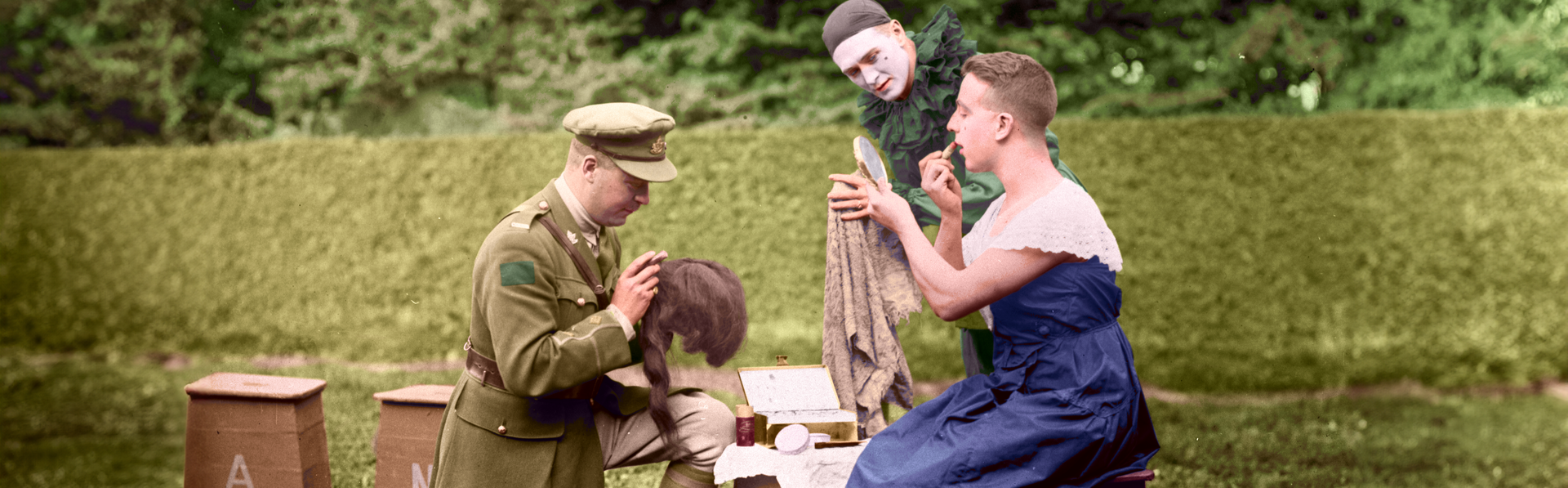
During the First World War, the Canadian government arrested and imprisoned its soldiers because of their sexual orientation. 110 years later, this website aims to tell the stories of the LGBTQ2s+ (Queer) individuals who fought for the country that saw their love as criminal. This web feature is arranged as a self-guided tour of important sites for Queer history along the Trail of Remembrance in France and Belgium.
To skip to a particular location for the interpretive content, use the menu bar at the top of the screen.
2 - Menin Gate, 3 - Poperinge Death Cells, 4 - Lijssenthoek Military Cemetery, 5 - Talbot House Museum, 6 - Essex Farm Cemetery, 7 - The Hill 70 Memorial, 8 - Canadian National Vimy Memorial, 9 - Cabaret Rouge British Cemetery, 10- Beaumont Hamel Newfoundland Memorial, 11 - Cartigny France, 12 - St George's Memorial Church.
If you would like to visit the sites in person, download this map to follow along:
Click here for a printable version of the map:
Before the outbreak of the First World War, Canada and Newfoundland were very different from how we know them today. Many people speak of the good old days without understanding the widespread discrimination faced by large swaths of the population. Women couldn’t vote and people of colour faced racism daily. This was particularly true for Black Canadians who experienced segregation laws and Indigenous people who continue to experience ongoing genocide under the Indian Act. Queer people also faced discrimination, especially from the Canadian government under what was known as gross indecency laws. Queer people were often arrested based solely on suspicion.1 Being romantically involved, living, and even dancing with another person of the same sex were grounds for arrest. When the First World War broke out in 1914, gross indecency was still illegal.2 These laws wouldn't be fully removed from the Canadian Criminal Code until 1987.3
Thousands of Canadians and Newfoundlanders fought in the First World War. For the first time in Canadian history, people were brought together from every corner of the country. Living through the horrors of war led many individuals to form close intimate bonds with members of the same sex.4 The normalization of same-sex intimacy allowed many Queer people to fall in love, for the first time, with less suspicion.5 While the war was filled with a lot of hardship and sadness for Queer people, it was also filled with beautiful moments of Queer joy.
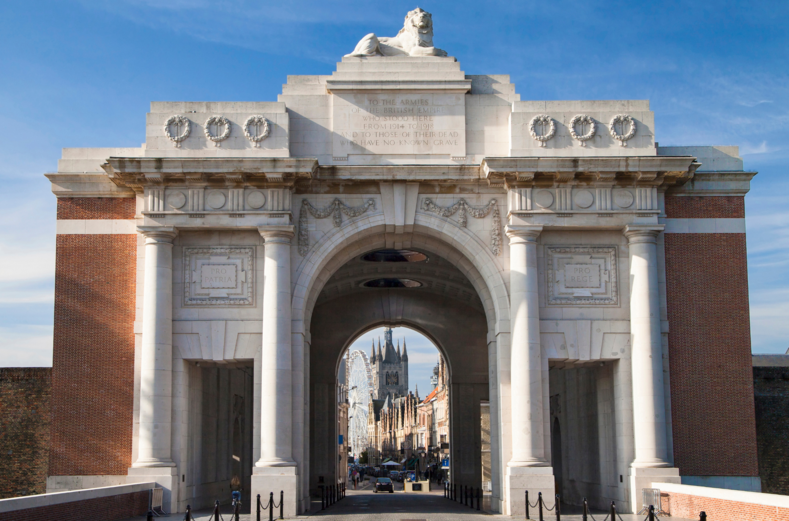
The Menin Gate in Belgium contains the names of 54,588 commonwealth soldiers who died during the First World War and have no known grave.6 Of those 54,588 names carved onto the memorial walls 6,940 are Canadians and Newfoundlanders. Every evening at sunset, there is a ceremony to commemorate the lives lost during the war.7 On the right-hand side of the memorial at panel 32, you will find the name of the only known Queer soldier on the Menin Gate: Private Alexander McKenzie.
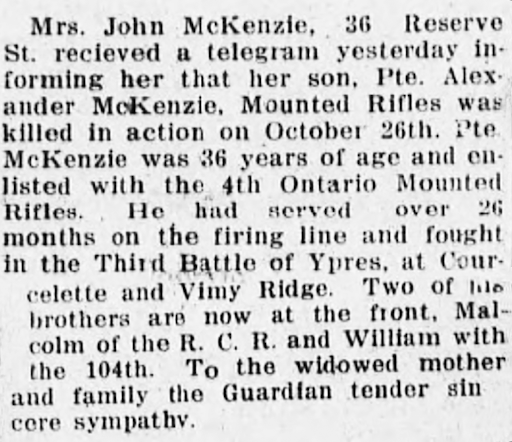
Private Alexander “Alex” McKenzie was born on June 5th, 1883, in Charlottetown, Prince Edward Island.8 The young private came from a large Scottish family and was raised on their family farm on the outskirts of the city. Shortly before the war, Alexander moved to Rodney in rural Ontario where he worked as a teamster driving animal carts to transport goods and equipment.9
After the outbreak of the First World War, Alexander followed in his older brother Malcolm's footsteps and enlisted with the 159th Battalion in February of 1916.10 After a short training period, the battalion set off for Halifax and Alex returned to his beloved east coast home, unknowingly, for the last time.
On the 31st of October in 1916, Alex embarked overseas with his battalion.11 Within two days of his arrival at the Seaford training base in England, Alex was arrested because of his sexual orientation. His official charge was listed as "disgraceful conduct of an indecent kind." 12 Alex was held in a military prison for over a month while he awaited his trial on December 13th.13 His trial, like many other Queer soldiers in the war, was filled with incredibly intimate and private details about his relationships. There were over three days of deliberations from the two captains and a lieutenant who served on the judge’s panel. Finally, on December 16th, the proceedings came to an end. Alex was publicly declared guilty and was outed to his entire battalion. He was sentenced to 90 days of detention at the Seaford base and spent his first Christmas away from home in a prison cell.14
The conditions in military prisons were incredibly harsh for incarcerated soldiers. They were frequently overcrowded, with up to four soldiers cramped into a small cell. The men were only allowed to leave to do manual labour or for their daily bathroom visits.15 Alex was released from prison in March of 1917. Shortly after, he was sent to Belgium with the 4th Canadian Mounted Rifles Battalion, where he would serve the remainder of his time in the war. On October 26th 1917, Alex was killed in action at the age of 34 while fighting at Passchendaele in Belgium.16 His body was never recovered amongst the sea of explosives, mud, and barbed wire of no-man's-land. As a result, he has no known grave and is commemorated on the Menin Gate.
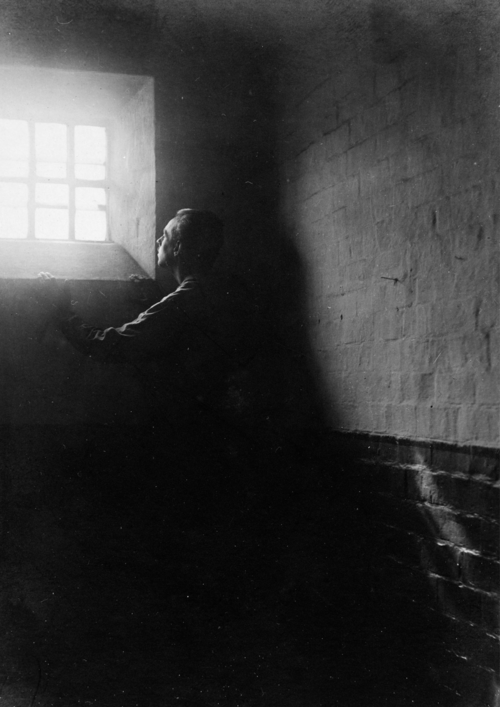
An estimated 22 Canadians and Newfoundlanders were arrested for consensual Queer relationships during the war. Of that number, 15 men were imprisoned.17 The records do not detail where the Queer soldiers were detained while they awaited trial but it was likely that they were in cells similar to the ones found at the former Poperinge town hall.
Sylvio Rousseau came from a large family and was raised in the city of Maisonneuve which is now part of Montréal, Quebec.18 He enlisted at age 17 in February of 1916. In July of that year, he travelled to England for training.19 On a summer evening in August, Sylvio was arrested alongside another French-Canadian soldier for disgraceful conduct of an indecent kind at the Dibgate military camp.20
Following his arrest, Sylvio was immediately placed into an overcrowded cell at a nearby military prison, much like the one still standing at Poperinge. In the distance, Sylvio could make out the sound of the court martial trials. He likely heard his fellow soldiers’ devastating pleas, screaming, and even the occasional gunshots from the firing squad, causing the cries to dissolve into silence.21
Sylvio spent ten days imprisoned leading up to his trial.22 On the day of his proceedings, Sylvio was led into a military courtroom to face a panel of judges. None of the officers on the panel were mandated to have any formal legal training, and yet his fate lay in the hands of the five men sitting in front of him.23 Because this trial fell under the military justice system, Sylvio was denied the right to legal counsel and a jury of his peers. Some soldiers, if they were lucky to know someone with legal knowledge, could appoint a prisoner’s friend to speak on their behalf. Unfortunately for Sylvio, he knew no one who could help him and had to represent himself. There was one major problem with this: Sylvio was a Francophone and did not speak enough English to defend himself.24 While the Canadian Expeditionary Force had official translators, they decided not to use them in this instance. Instead, his commanding officer gave a brief defence on his behalf, saying:
“The accused is a French boy and cannot speak English, he is under military age, being only 17 years old and in my estimations is mentally unbalanced.” 25
The witnesses in his trial shared graphic testimonies about the private moments between Sylvio and the other soldier. Court was then adjourned and Sylvio was sent back to his detention cell to await the verdict. To promote what officials deemed military discipline, the results of court martial trials were declared in front of the entire base.26 This meant that when Sylvio’s verdict was read out as guilty the next day, he was outed to hundreds of his fellow soldiers. He was ordered to undergo 90 days in a military detention centre and publicly shamed simply because of who he found attractive.27
By 1918, he faced another sentence by a court martial for a military misdemeanour. To escape being imprisoned again, Sylvio attempted to run away but shortly after he was caught and served another three months in a military prison.28 In 1919, Sylvio returned to Canada and was demobilized. Not much is known about Sylvio's life following the war, but he eventually met and married his wife, Ida Maxwell. Sylvio died at the age of 37 in 1937.29
The 70,000-75,000 Francophones who served in the Canadian Expeditionary Force (CEF) faced significant discrimination.30 Many were placed in battalions where the instruction language was English. Additionally, 1 in every 4 Francophone volunteers was rejected on enlistment.31 French Canadians like Sylvio Rousseau were also disproportionately impacted by Queer persecution. Despite representing only 12% of the CEF enlistment population, French Canadian soldiers accounted for roughly 32% of the court martial for gross indecency.32
Boescheepseweg 37, 8970 Poperinge, Belgium
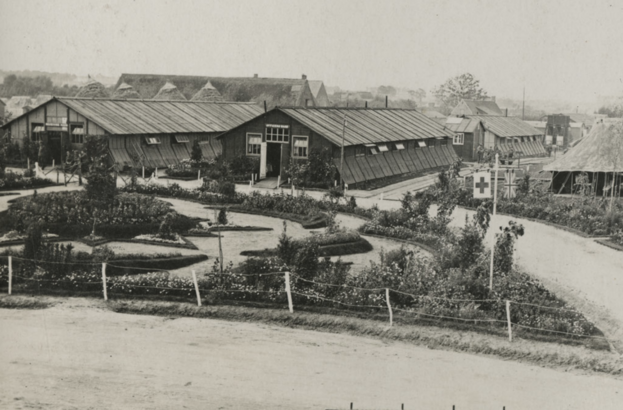
The Lijssenthoek military cemetery was once the location of a casualty clearing station known as Remy Sidings.33 Today, the site is a Commonwealth War Graves Commission cemetery that is the final resting place for 10,784 individuals who fought in the First World War.34 There is a visitor centre that focuses on the important role of military personnel during the war. Many Canadians and Newfoundlanders served at Remy Sidings, including two Queer nursing sisters by the names of Mildred Forbes and Laura Holland.35
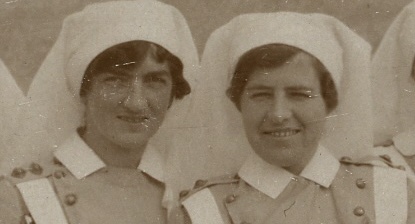
Laura Holland and Mildred Forbes grew up in the same circles in Montreal.36 In the years just before the war, they moved in together and became an inseparable pair.37 On May 3rd, 1915, they enlisted as nursing sisters in the Canadian Army Medical Corps. Both women were already fairly established in their careers. At the time of their enlistment, Laura was 31 and Mildred was 30.38
From the moment they enlisted, the women swore they would do whatever they could to remain together.39 In June of 1915, Mildred wrote in a letter to Laura’s mother that she would rather “be torpedoed” than separated from Laura.40
Shortly after they arrived in England, Laura and Mildred were offered placements in Lemnos, Greece, near the Dardanelles campaign. The couple accepted right away, regardless of how daunting the journey seemed. Laura explained her reasoning in a private letter to her mother:
“We were given half an hour to decide. I didn’t hesitate, for I felt the next place offered we might not like & would feel bound to accept, whether we would be together or not, & the fact of our being together meant more than everything…”41
They set off from Folkestone in July of 1915, to Lemnos, an island in the Aegean Sea.42 While there, the women shared a canvas tent that they affectionately called their little “home.”43 While each nurse at Lemnos was eventually assigned private accommodations, Mildred and Laura opted to combine theirs. One part became their shared bedroom and the other was a sitting room for friends.44
Their time in Greece was bittersweet, both of them became ill on multiple occasions and the workload was exhausting.45 They often had to care for severely infected wounds with minimal supplies. Yet at the same time, they got to see some of the most beautiful parts of the country and culture. During one of their many private moments, they snuck away from camp and watched the sunset over Mount Olympus together.46
In the summer of 1916, Mildred and Laura were notified that they were to return to England.47 There, Mildred accepted an offer to work as the right-hand woman to Matron in Chief of the nursing corps, Margaret Macdonald.48 However, the couple soon learned that they would not be provided shared accommodations.49 So, instead of living in separate quarters, they rented a one-bedroom apartment at their own expense.50
The placement in London was essential work but both Mildred and Laura longed to be closer to the action. At first, Mildred was offered a matronship at a brand-new hospital in the South of England.51 However, much to the chagrin of her family, she declined. As Laura explained, the couple felt it wasn’t “altogether wise for a Matron to have a ‘special friend’ in the Unit, unless as her assistant, which would mean we could never be away together.”52
In July of 1917, the women got their wish and were stationed at the NO.2 Casualty Clearing Station, also known as Remy Sidings. The work was long and hard, and they witnessed firsthand the horrors of the Western front.53 Mildred was eventually promoted to Acting Matron at the station and stayed until August of 1918. Following that period, Mildred gave up her matronship so that she and Laura could be stationed together at a hospital in the South of France.54 For the remainder of the war, they worked in small-scale hospitals. In 1919 they returned to Canada together, settling in Montreal.55
Sadly, their story does not have a happy ending, unlike other nursing sisters who got to live out the rest of their lives together.56 On January 8th of 1921, Mildred underwent an operation to remove an intestinal ulcer and her surgical incision hemorrhaged. She had a second operation to stop the bleeding but it failed.57 On January 13th, 1921, Mildred passed away surrounded by her loved ones. Laura outlived Mildred by 35 years, had a long career working as a social worker, and was made Commander of the British Empire for her accomplishments.58 She never married and passed away in 1956 in Victoria, British Columbia.59
Gasthuisstraat 43, 8970 Poperinge, Belgium
Soldiers and nursing sisters were granted leave on average 10-14 days a year in the British and Canadian Expeditionary Forces.60 North America was typically too far a journey to visit home, so instead, many Canadians spent their free time visiting cities and cultural sites in unoccupied areas of Europe.61 Poperinge, or the "Little Paris," was a popular destination for soldiers to spend their leave.62 The Talbot House is situated right in the centre of the town and was opened up as a soldier’s club by the chaplain Philip Clayton. The Talbot House's core philosophy was “all rank abandon yee who enter here.”63
During their time off, soldiers and medical personnel frequently attended performances by concert troops.64 These troops often included “female impersonators,” known today as drag.65 While it wasn’t exclusively Queer at the time, drag was one of the few sanctioned ways for Queer individuals to receive attention from members of the same sex and even participate in public displays of Queer affection.66 The concert hall at the Talbot House is one of the only concert halls still standing after the war.
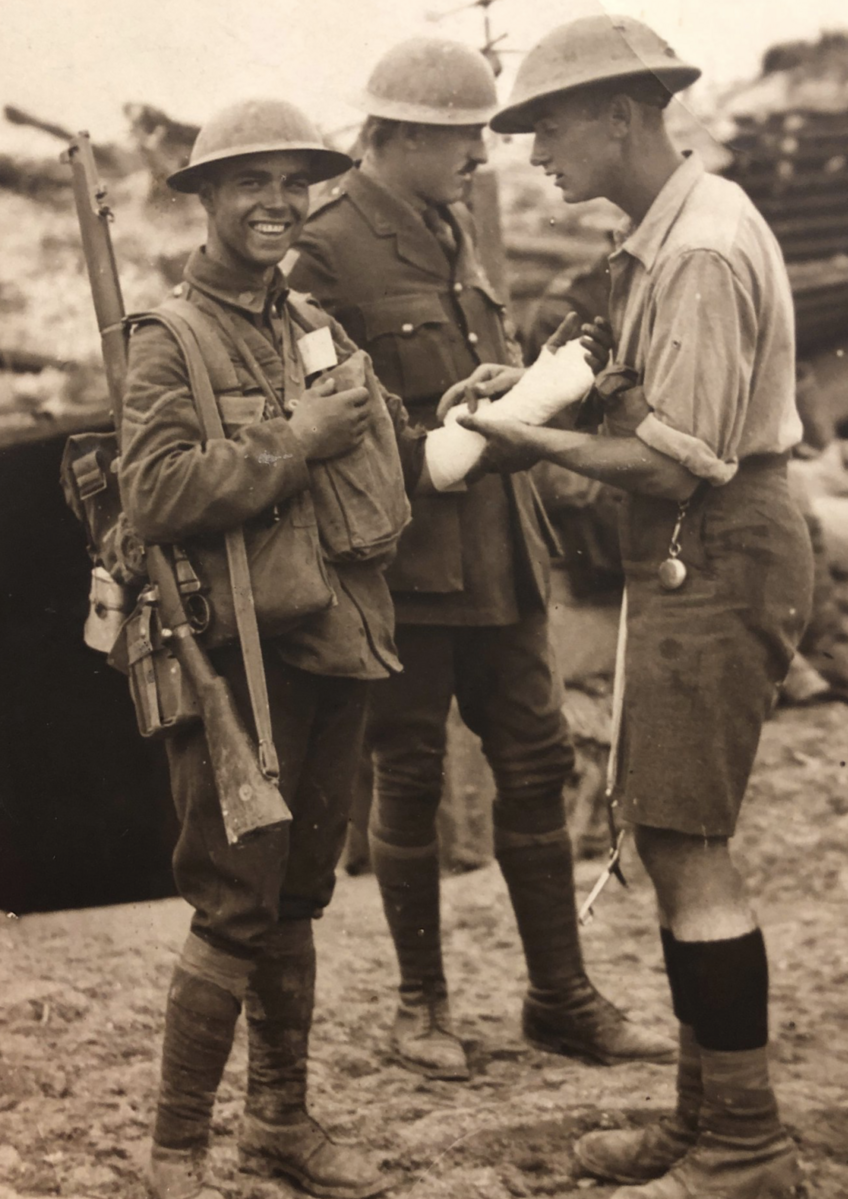
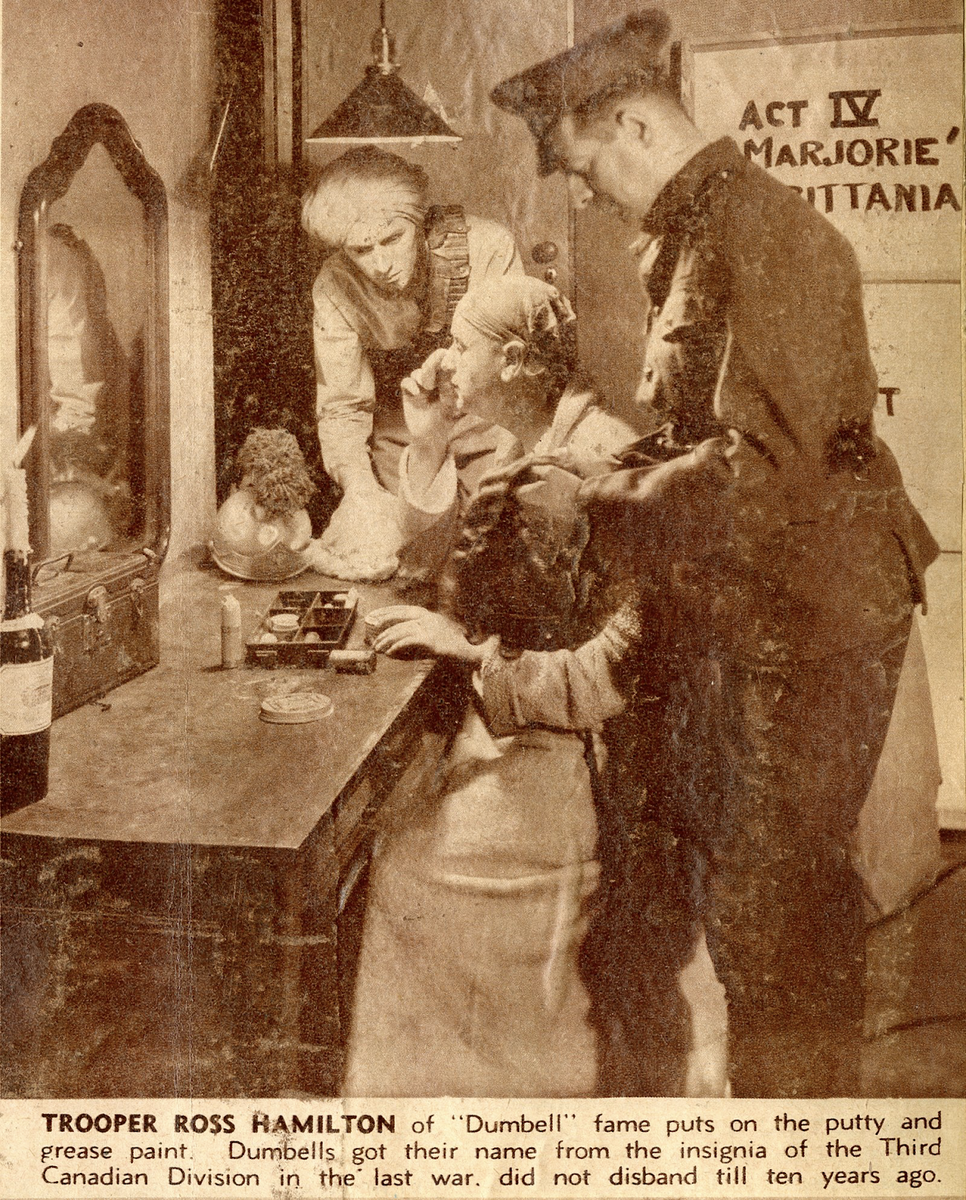
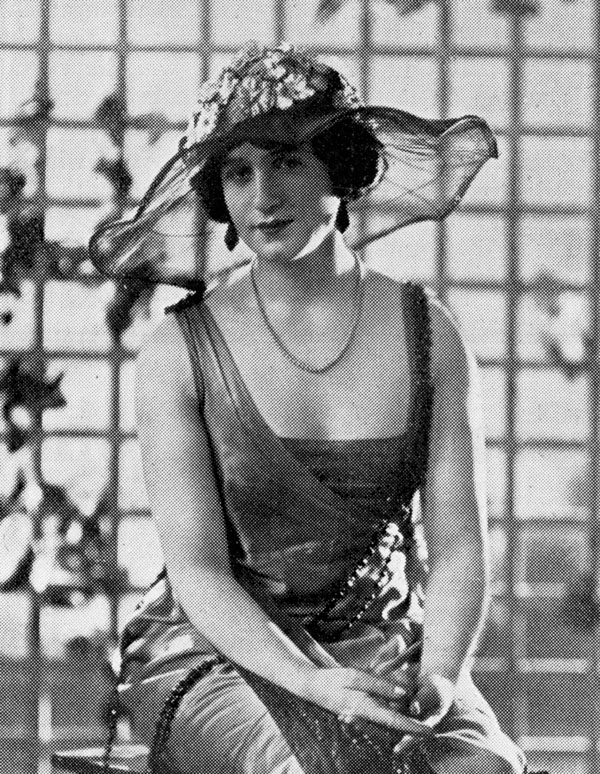
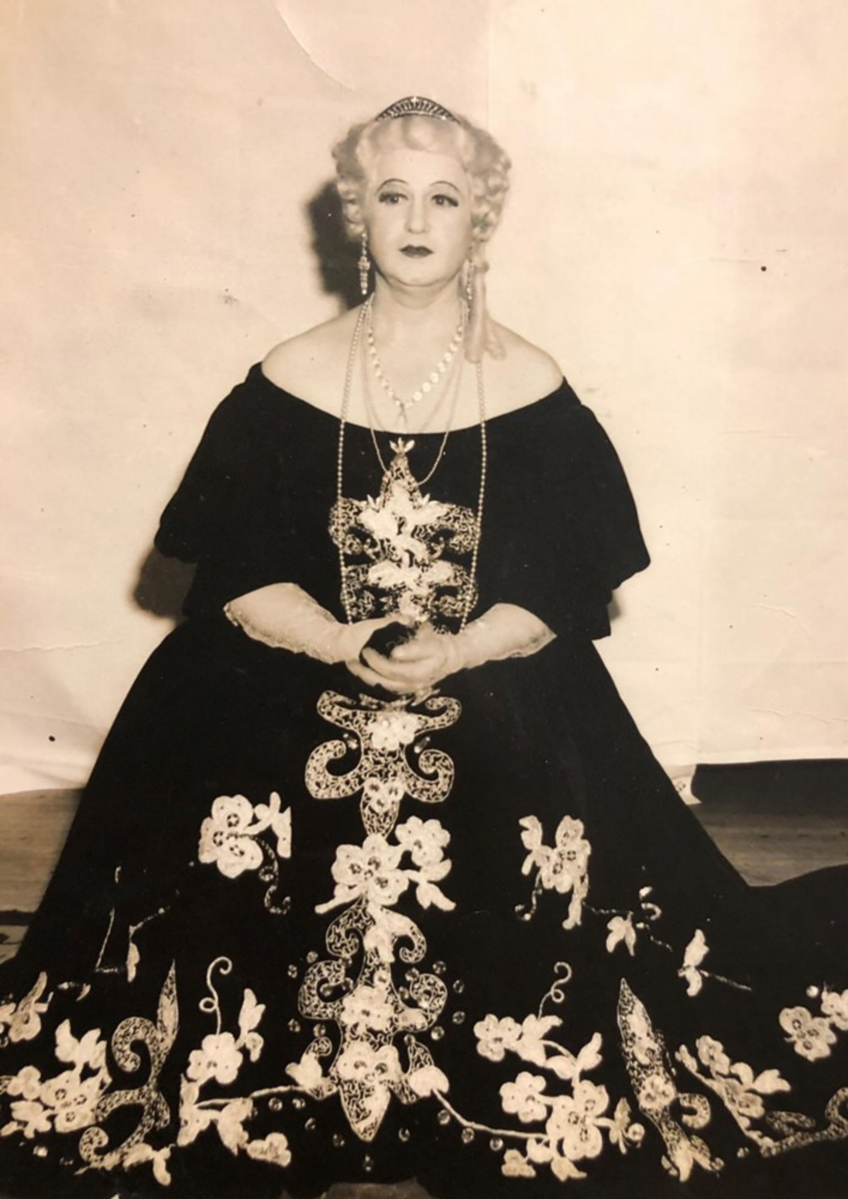
Ross Douglas Hamilton was born in 1892 in Pugwash, a town on the north shore of Nova Scotia.67 After graduating from high school, Ross moved from Nova Scotia to Montreal. There, he found work as a clerk and in his spare time dabbled in theatre.68
When the war broke out in 1914, he enlisted in the medical corps as a stretcher bearer.69 Ross’s drag character Marjorie was created on the road to Vimy Ridge. Ross’s good friend and fellow drag performer, Alan Murray, crafted Marjorie's first outfit out of tent canvas, curtains, feathers from pillows, and beads from rosaries. Ross held on to that first costume as a memento for the rest of his life.70 Marjorie's first performance took place in early April 1917, just days before the major offensive began.7 Ross and Alan eventually joined the Dumbells concert troop and went on to tour the front lines with them for the remainder of the war.72
Ross did all of his makeup for the shows and used to arrive backstage before the rest of the team to get ready.73 The group performed everything from comedy skits to emotional ballads about lovers separated by the war. Ross was so popular that he often had to change out of costume before going back to the barracks for fear of being mobbed.74
After the war, Marjorie and the Dumbells toured North America and Europe, including shows at the Coliseum in London, a performance for the King of Belgium, and 6 weeks on Broadway.75 When the Second World War began in 1939, Ross signed up for the medical corps. Once again, he found himself travelling around Europe performing for Canadian soldiers but this time, Marjorie was a middle-aged classical opera singer.76
Tragically, after one of his shows Ross was outed to military authorities. He was quietly discharged for reasons other than medical, which was commonly used phrasing when dismissing Queer soldiers.77
Like many other Queer people throughout history, Ross found the strength to persevere in his retirement. He built a charming log cabin near Truro, Nova Scotia, and spent the other half of his time in his hometown of Pugwash.78 Ross lived a well-deserved quiet life in his later years and spent his time volunteering with the community theatre, tending to his garden, and reading. He was known for being an incredibly generous and warm person who became a pillar of his home community.79 He died in 1965 at the age of 76.80 Until recently, Ross’s legacy has largely been erased from the history of the First World War because of his sexuality.
87Diksmuidseweg, 8900 Ieper, Belgium
Medical care in Canada was revolutionized during The First World War . In the early years of the war, the Canadian Army Medical Corps (CAMC) saw significant expansion.81 The war involved the first widespread use of mobile blood transfusions, the invention of skin grafts, and x-ray machines.82 From 1914-1919, an estimated 21,453 individuals served in the CAMC.83 This includes doctors, ambulance drivers, stretcher bearers, and over 2,800 nursing sisters.84 Additionally, thousands of Canadians and Newfoundlanders signed up with the Voluntary Aid Detachments through the Red Cross and St. John Ambulance.85 Essex Farm Cemetery was once the site of an advanced dressing station used by Canadian medical personnel, including the famous author of In Flanders Fields, John McCrae.86
Much like medical care, gender roles also changed radically during the war. Women and people assigned female at birth (AFAB) worked in areas that would have been impossible in 1913.87 On the home front, they worked as clerical workers, in factories, and agriculture.88 They also enlisted in droves for overseas services with organizations such as the Canadian Army Medical Corps, Queen Alexandra's Royal Army Nursing Corps, St. John Ambulance, the Red Cross, and the YMCA.89 However, women and AFAB people were forbidden from serving directly on the front lines.90 Working as ambulance drivers for advanced dressing stations, like the one at the Essex farm cemetery, was the closest they were allowed to the front lines.91 This rule, however, did not deter Jo Whitehead from serving.
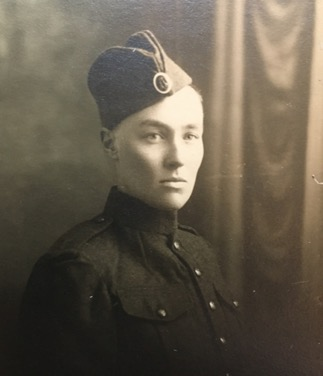
Jo Whitehead lived most of their life defying society's rules and regulations when it came to what to wear, how to act, and who they had to be to fit in. Jo was the oldest child of the industrialist, Charles Whitehead, and was born in Trois-Rivières, Quebec in 1895.92 They were known for their adventurous spirit and gender diversity from a young age. Jo was reported in news articles as being known for their propensity to wear “semi-male garb on [their] tramps through the woods” and that they “could handle a canoe or shoot better than most men.”93 Jo also excelled academically and received several accolades throughout their education, including the highest grades in their Latin and German courses.94
This talent for learning languages would prove especially useful when they served in the First World War. Jo first enlisted with the Voluntary Aid Detachment in London but increasingly became frustrated with how they were treated as a person who was AFAB.95 What Jo wanted more than anything was to fight on the front lines, or at least as close as possible.
The determination led Jo to enlist a second time as an ambulance driver with the Serbian Relief Fund on the Eastern Front.96 Within months of their arrival in Serbia, Jo enlisted on a third and final occasion, this time presenting as a man. They served as an infantry soldier in the 9th Serbian Regiment and started working as a lieutenant in the Serbian Veterinary Corps.97 To date, they are the only known Canadian who was AFAB to see direct combat in the First World War. For the first time in Jo’s life, they could express their masculinity without question. Sadly, that freedom abruptly ended in October of 1915 when Serbia became occupied by German and Austro-Hungarian forces.98
It was in occupied Serbia that Jo’s skills and intelligence became more important than ever. They eventually ended up helping the Scottish Women’s Hospitals in the region, which faced an increase in looting and violence in the aftermath of the occupation. According to Dr. Catherine Corbett’s diary, Jo was particularly useful when guarding their storerooms because of their masculine gender presentation.99 Many looters assumed that Jo was a man, and were less likely to attack the hospitals. Jo also protected the women from sexual assault. Dr. Corbett wrote in her diary that: “it is rather convenient having a man about who is a girl.” 100 In addition to their job protecting the women at the Scottish Women's Hospitals, Jo greatly enjoyed working with mechanics. They created several disinfectant machines for hospital patients' clothes and blankets.101
In mid-November of 1915, Jo was captured as a prisoner of war by Bulgarian soldiers and imprisoned in a camp in Kruševac. However, their resourcefulness and mechanical skills were noticed by Bulgarian officials and Jo became employed by a German doctor.102 While in the prison camp, Jo met and married their first husband, Vukota Vojinović. In February of 1916, after months of diplomatic efforts, the couple was finally repatriated to Canada.103 Unfortunately, their marriage was not a happy one. Jo filed for divorce in 1927 on the grounds of extreme cruelty, citing that their husband's violence began when they first met during the war.104
Following their divorce, Jo returned to their maiden name, Whitehead, and gained full custody of their four children. A few years later, Jo remarried an American named George Andrew Vaughan, and they had one other child together.105 The family moved to British Columbia and settled on a ranch in Mazama, just on the outskirts of Kamloops. Finally, after years of turmoil, Jo returned to doing what they loved best, living and working outdoors. In 1964, Jo passed away at the age of 69 following a long battle with stomach cancer.106 According to conversations the historian Dr. Natasha Stoyce has had with living descendants, Jo maintained their gender nonconforming appearance for the entirety of their post-war life.107 In fact, the barber that they frequented did not know Jo was assigned female at birth until after their death. Their living descendants assert that Jo lived their life as a gender-diverse individual and may have identified as non-binary today.108
In August of 1917, the Canadians endured a brutal struggle for Hill 70 and lost thousands of lives during the battle.109 The Hill 70 Memorial commemorates those who were lost and the significant victory in the war for the Canadian Expeditionary Force. The memorial and surrounding park were opened in 2019 after years of advocacy by dedicated volunteers.110
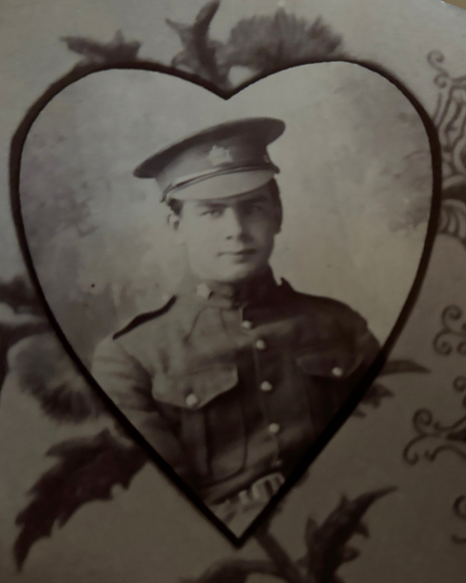
Frederick Lea Hardy was born in Strathroy, Ontario in 1898. As a young boy, he moved with his family from Strathroy, Ontario to Brandon, Manitoba.111 During his childhood, he lived on a family farm on the city's outskirts and spent his summers working the endless fields of wheat that dotted the prairie landscape. Following his brother’s footsteps in 1915, Frederick enlisted in the Canadian Expeditionary Force at only 16 years old.112 He served with the 8th Battalion in France and Belgium.113 After an intense period of battle in July of 1916, the 8th Battalion returned behind the lines for a period of rest. They were billeted in the town of Abele, a ten-minute drive from Poperinge.114
On the night of July 7th, Frederick went to a nearby estaminet with a fellow soldier named Albert Goulet. Estaminets were a type of bar and restaurant that were run by locals in the regions of Flanders and Northern France.115 Later that evening, Frederick was arrested in a nearby hop field, along with his partner, for gross indecency with another male person. He was detained in a holding cell overnight, and the next morning was put on trial in a military court martial.116 Frederick was not provided with a lawyer and was forced to represent himself.117 After the court adjourned, he was confined in his cell for two days. Like many other Queer soldiers, Frederick was declared guilty in front of the entire encampment at Abele, outing him to hundreds of his peers. He was ordered to undergo 18 months of forced labour imprisonment in England and served his sentence at HM Winchester.118 During this time, the main goal of the British penal system was to systematically dehumanize incarcerated individuals.119 They were forced to wear an identity disc around their neck and were known only by those 5-6 numbers. In prison, Frederick was forced to complete manual labour for roughly 10-12 hours a day. The bed in his small cell consisted of a rigid plank board with pillows and blankets made up of rough coconut fibre and he was allowed only one shower per month.120 Even though each prisoner had a cell, this did not guarantee any form of privacy. Each door was equipped with a spy hole that the warden could watch them through without their knowledge. One of the hardest parts of the imprisonment was the forced silence. Incarcerated men were forbidden from speaking unless it was to make a formal request or talk to the prison’s religious chaplain.121
In April, 1917, the Canadian Expeditionary Force became desperate for soldiers in the wake of the significant number of casualties at Vimy Ridge. As a result, Frederick's sentence was remitted, and he found himself once again in the trenches on the Western Front back with the same battalion he had been outed to just months earlier.122 In August, 1917, Frederick fought at Hill 70 in France and was killed on the first day of the offensive on August 15th, 1917.123 His body was never recovered and as a result he has no known grave. Frederick died fighting for a country that viewed him as a criminal and spent some of the last months of his short life imprisoned simply because he was Queer. To date, Frederick Hardy is the only known Queer soldier to be commemorated on the Vimy Memorial.124
Route départementale 55, Chem. des Canadiens, 62580 Givenchy-en-Gohelle, France
Private Frederick Lea Hardy’s name can be found on the back of the monument on the left-hand side. While Frederick is the only known Queer soldier on the memorial, he is undoubtedly not the only Queer connection to the site. Thousands of Canadian and Newfoundland soldiers and nursing sisters passed through Vimy throughout the war. That number includes several Queer soldiers who served there during the Vimy Ridge offensive. This number includes nursing sisters Ellanore Parker and Murney Pugh who tended to the endless stream of wounded soldiers while stationed at the No. 2 Canadian Stationary Hospital in April of 1917.125
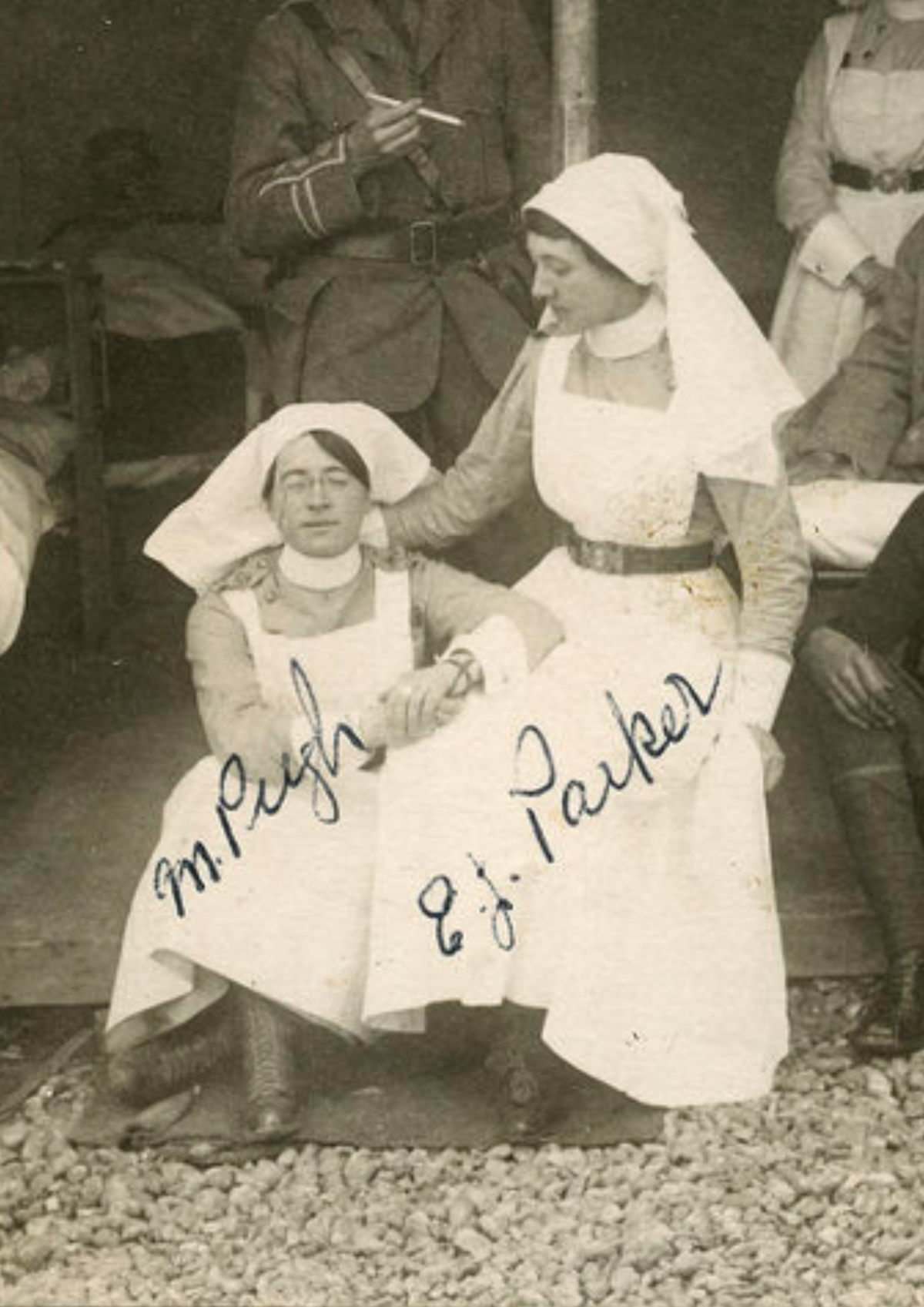
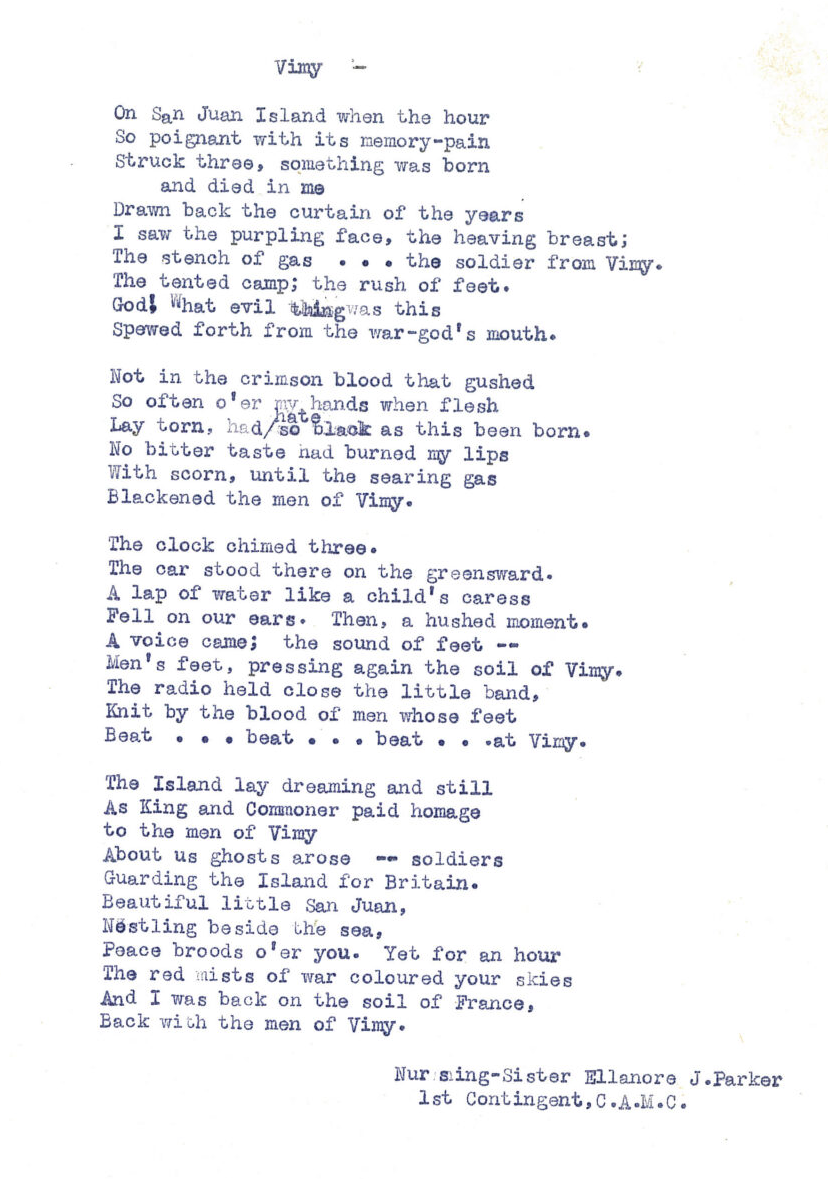
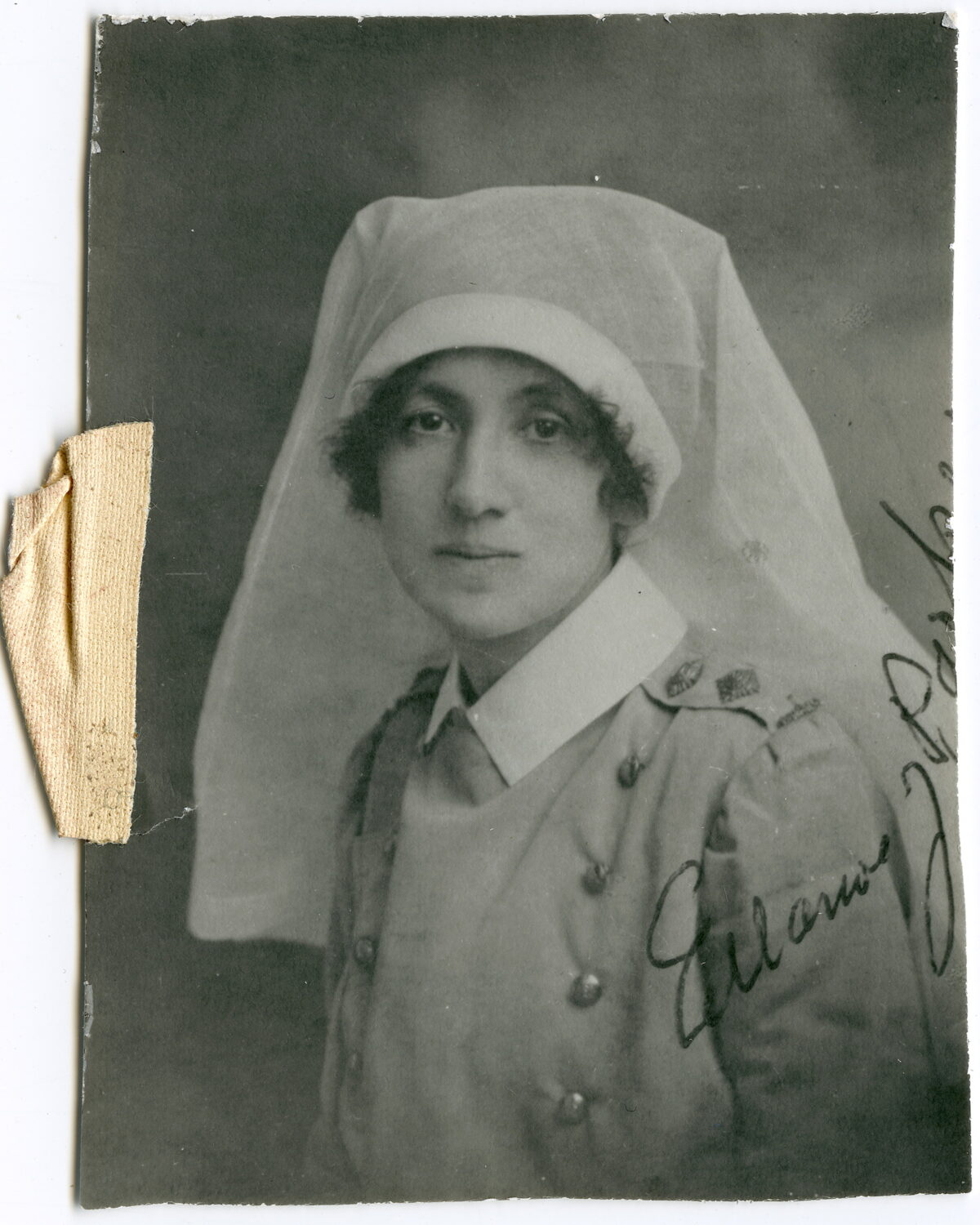
In 1908, at the age of 30, an intrepid Irish woman named Ellanore Parker moved halfway across the world to the sprawling grasslands of the Canadian Prairies. She crossed the Atlantic Ocean and left her old life behind to start anew at the Winnipeg General Hospital’s nursing school.126 Ellanore graduated from nursing school in 1910.127 She was amongst one of the first contingents of nursing sisters to enlist from Manitoba.
Meanwhile, thousands of kilometres away on the East Coast, Murney Pugh had just graduated from her nursing training at the Royal Military Hospital in Halifax.128 Murney was raised in the British army's garrison, Fort Henry, near Kingston, Ontario. She was born in the Striking Stone Tower at the fort in 1883 and was named after the tower.129 In early September 1914, Murney made the long train journey from Nova Scotia to Quebec to enlist as a nursing sister in the Canadian Army Medical Corps (CAMC).130
Shortly after their enlistment, both women were sent overseas to England for brief training before they were sent to hospitals in Boulogne, France.131 Despite being stationed in nearby hospitals on the French coast, the women somehow did not cross paths for the first year that they served. They first met while working at the Netheravon House on Salisbury Plain in 1915, a Georgian building that had been converted into a wartime hospital.132 It is unknown how exactly the women first met, but from that moment on they were inseparable. From billeting in a French Chateau to waiting out torrential rains in tents on the Somme, one thing remained consistent: they had each other.
In early 1917, while treating victims of chlorine gas poisoning, both Ellanore and Murney became poisoned by the lingering gas on their patient’s clothing. The gas first caused a burning pain in the victim's throat and eyes quickly turning into the sensation of being suffocated from the inside out.133 For Ellanore, this incident impacted the rest of her life in the form of post-traumatic stress disorder and the permanent physical damage that the gas poisoning caused. Eventually, Ellanore’s disability caused her to deal with chronic bouts of weakness and she became unable to work for long periods at a time. Unfortunately, she eventually had to give up her career as a professional nurse.134
Following the end of the war in 1918, the couple moved to West Hollywood with the hope that California’s climate would help with Ellanore’s lungs. West Hollywood in the 1920s was the city's central area for underground Queer bars, and it had a flourishing Queer cinema industry.135 It was only in that atmosphere that the pair felt safe to self-identify as partners on two separate U.S. census documents.136
While in California, Murney continued to work as a nurse, while Ellanore began her literary career. Because her disability resulted in chronic periods of bronchitis, Ellanore often wrote from her bedside. She would write ideas on scrap paper that she would then stash away in notebooks. She published two books in her lifetime: “The Flower of the Land: A Tapestry of the Great War” and “Land Lay Waiting." She also authored several pieces in the Los Angeles Times, including several poems which were never formally published.137
During the Second World War, Ellanore contributed to the war effort from their home through her inventions. She created a water cannon which was crucial in the fight against air raids in London. She also invented a magnetic detector that provided the foundation for what became radar technology.138
In 1948, the couple returned to Canada and settled down in a newly constructed bungalow in Victoria, British Columbia.139 They remained there until 1965, tending to their beloved garden. After a lifetime of chronic illness, Ellanore was suddenly hospitalized for a stroke in October, 1965 and died shortly after at the age of 86.140 It is unknown whether Murney was with her in her last moments. Before the legal recognition of same-sex domestic partnerships in 1999, Queer partners were often forbidden from hospital visitation because they were not legally considered family.
It is because of Murney’s undying dedication to Ellanore’s memory that the story of their love is preserved today. Ellanore had never intended for her work to be read, but Murney saw her talent and knew that it must be shared with the world. She said in an interview that Ellanore has “always been much too modest."141 Murney donated all of Ellanore's unpublished writing and their wartime scrapbooks to the Royal BC Museum shortly before her death in 1974. She was buried in a shared grave with Ellanore in Victoria, British Columbia.142
5000F Rue Carnot, 62153 Souchez, France
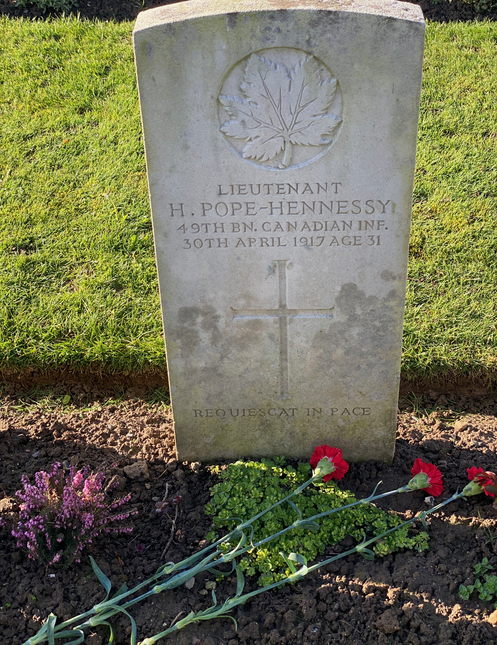
Lieutenant Hugh Pope-Hennessy was born in Mauritius in 1885.145 He was the youngest of three brothers and spent the early years of his childhood being raised as an only child because his brothers were away at boarding school. While living on the largely Francophone island, Hugh quickly learned French and was nicknamed “Le petit Mauritian.”146 However, Hugh and his family experienced a great deal of racism growing up because Hugh’s mother was half Malaysian.147 When Hugh was around 5 years old, his father retired from colonial administration and politics. The family moved back to Ireland and settled on a large estate in Cork. Within two years of their return, Hugh's father died. Hugh was only 7 years old, and his mother, now widowed, quickly remarried.148 Following his older brother’s footsteps, and during his teen years, Hugh was sent to England for boarding school.149 After graduation, Hugh moved to Canada to seek a new life in the Prairies.
At the beginning of the war in September of 1914, Hugh enlisted with the 3rd Engineers and by 1915, he was appointed as temporary Lieutenant.150 Hugh was a well-loved officer and was affectionately nicknamed “The Pope” by the men in his unit.151 Despite his reputation, Hugh was arrested, detained, and tried for gross indecency in March, 1917. Unlike some of the other soldiers during the war, Hugh was very fortunate during his trial to have the battalion’s major testify on his behalf. As a result, he was declared not guilty. Although he was not found guilty, Hugh was still arrested and had to undergo the humiliation of having some of his most intimate moments read out in front of the entire courtroom.152
Within weeks of the trial, Hugh fought at Vimy Ridge and was injured on April 9th, but made it out of the offensive safely. However, on April 30th 1917, two months after his arrest, Hugh was killed in action at the age of 31.153 He was wounded while doing routine rounds at an observation post with another lieutenant. It was initially reported that Hugh was alive and among the injured, but it was later reported that he had died from his injuries.154 He is buried at the Cabaret Rouge Cemetery. In a sad twist of fate, decades later in the 1970s his nephew, James Pope-Hennessy, a well-known gay author and London socialite was murdered.155
Rue de l'Église, D73, 80300 Auchonvillers, France
The Beaumont Hamel Newfoundland Memorial was created to commemorate the Newfoundland soldiers, merchant mariners, and royal naval reservists who died in the First World War and have no known grave. However, the site has since taken on a much bigger meaning for Newfoundlanders and Labradorians. For many, the site symbolizes all of the individuals who fought for the dominion, and whose lives were forever changed by it.
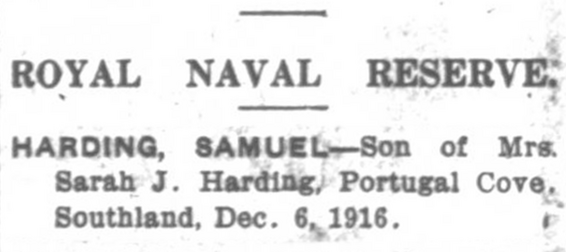
Samuel Harding was born in the small fishing community of Portugal Cove, Newfoundland in 1901.156 He was from a long line of fishermen, and by the age of 16 was already very familiar with navigating the unpredictable waters of the North Atlantic.157 Inspired by his brother, Henry, Samuel enlisted in the Royal Naval Reserve (RNR) on November 13th, 1916, at the age of 15.158
While serving on the HM Richard Welford in Gibraltar, Samuel met and developed feelings for the Scottish seaman, George MacDonald. Under the constant threat of torpedoes and rough waters, the two men formed a connection. Shortly after, on November 6th of 1918, they were arrested for gross indecency with another male person. Both men were imprisoned for a year at the Horfield Prison in Bristol. They were eventually sentenced to be dismissed with disgrace.159 Like Frederick Hardy, and many other Queer soldiers during the war, Samuel was dehumanized, humiliated, and brutalized while in the British prison system.160 He was subjected to long hours of forced labour and received only rations for food.
Even though the war had ended just days after his sentencing, Samuel was not demobilized with the rest of the RNR.161 Instead, he was forced to serve the remainder of his sentence. Samuel was finally released from prison after 12 months in November of 1919 and travelled back to his home in Newfoundland shortly after.162 When Samuel returned to Portugal Cove, his community was in the midst of a tuberculosis outbreak. His weakened immune system from his time in prison meant that he soon became sick himself. Samuel eventually died of Tubercular Meningitis in February of 1920, at the age of 18.163
Samuel has no known grave marker, but his name was included on the community's war memorial honouring community members who served in the First World War. Samuel is the only currently known case of a Queer Newfoundlander who served during the war, but he is surely not the only one.
The climate of racism that consumed North America before the war remained unchanged after the war was declared on August 4th, 1914. Racism was integrated into every aspect of the Canadian Expeditionary Force.164 Racialized individuals were subjected to violence, prejudice, and mockery, from both their superiors and peers.165 Racism even extended to entertainment, where concert parties frequently featured blackface and racist jokes.166 Thousands of Black, Indigenous, South Asian, and East Asian soldiers served in the CEF, despite the discrimination.167 Some of the most devastating examples of racism during the war were experienced by Black Canadians. At first, many were turned away from enlisting, but after two years of advocacy Black men were allowed to join the No.2 Construction Battalion.168 The battalion went on to become the largest Black battalion in Canadian military history. The men of the No.2 battalion faced anti-Black discrimination and violence regularly while serving their country.169 Their unjust treatment included strict segregation rules, medical neglect, racist harassment, and outright violent attacks by white soldiers.170 This culture of racism contributed to the murder of Private Charlie Some, who was attacked by a French soldier.171
Cartigny, the small town just outside of Péronne, is at first glance indistinguishable from the neighbouring villages of Hancourt and Buire-Courcelles. Its streets are lined with red brick houses, and on its outskirts are vast green farmer's fields. Yet, the town is remarkable because it has a direct connection to the first and only all-Black battalion in Canadian history: The No.2 Construction Battalion. The battalion mainly served in the southeast of France working as a forestry unit. In 1917, however, 50 members of the battalion were sent to Cartigny in the Somme region. This was one of the only areas close to the front lines where members of the battalion served.172 To date, there is no monument dedicated to Black Canadian soldiers in Northern France or Belgium. There is only one overseas monument located in the small village of Supt, France. The small community has a specific monument dedicated to the No.2 Construction Battalion and the Black Canadians who served in it.173
Although there is no physical monument in the area of Cartigny, it is a location along the remembrance trail where people can follow the path of the battalion and reflect on their experiences of discrimination while serving their country.
Private Louis Nealy was born in Chicago in 1886 and before the war he worked as a barber in his home state of Illinois.174 He was the sole provider for his family and worked long hours to support his widowed mother, Emily.175 In November of 1916, Louis made the 460 km train journey to Windsor, Ontario to enlist in the No.2 Construction Battalion. He travelled with the other recruits to England in July and was eventually posted to Jura in South Eastern France with the rest of the No.2 Construction Battalion.176
In January of 1918, Louis was arrested for disgraceful conduct of an indecent kind after he spent the night in a hut for white soldiers, and not in the segregated hut for Black soldiers in No.2. It is unclear in the historical records if Louis was Queer, or if the charge was raised against the soldier as punishment for breaking segregation rules.177 Notably, Louis's treatment during his trial was very different from white Canadians who were arrested because of their sexuality. The witnesses’ testimonies were filled with graphic racial slurs about Louis, and the court ordered him to call on a white soldier to testify on his behalf for his defence to be taken seriously.178 He was given the verdict of not guilty, but much like Lieutenant Pope-Hennessy, Louis had to endure a brutal trial where his personal life was put on display to the court.
Six months following his court trial, Louis found himself in trouble with the military law once again. He was arrested because he defended himself with a razor blade during a fight with another soldier who had attacked him first.179 Louis was found guilty of assault with the intent to do bodily harm, and he was sentenced to 18 months of imprisonment with hard labour. He served four months of his sentence at the No.6 military prison located in France.180 In February of 1919, the military prisons in France were closed down and he was released in the United Kingdom. Sadly, it is very difficult to track what happened to Louis after that. He does not appear on the 1920 US census or the 1921 Canadian census. His proposed residence in his discharge papers suggests that he found work at a bookstore in Ripon , England. Ship passenger lists show he made his way back to North America in late 1919.181 According to Illinois state records, Louis died on May 30th, 1975 at the age of 89.182
Queer discrimination was meant to scare all Queer Canadians into keeping their identities a secret. The stories that are told here come from the few remaining physical records of Queer lives during the First World War. They are, however, just a fragment of the experiences of Queer people who lived during this time. Thousands of Queer individuals were impacted by and suffered from these laws. Sadly, there are no records for these victims but they should be recognized and commemorated nonetheless.
Elverdingestraat 1, 8900 Ieper, Belgium
St. George's Memorial Church was constructed after the First World War as a place of worship for many of the loved ones who visited the Ypres Salient. There are hundreds of memorial plaques that adorn its walls to different regiments and individuals who fought on the Salient.183 In the church, a plaque can be found commemorating the 4th Canadian Mounted Rifles which was the regiment that the Queer poet and journalist, Charlie McDonell, served with.184
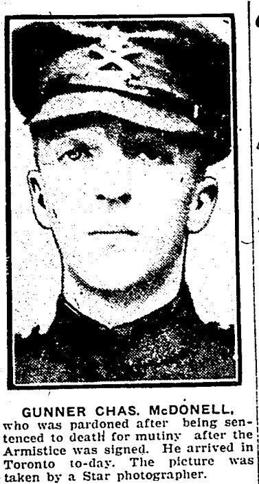
Trigger Warning: this story mentions suicide
Charles "Charlie" McDonell was born in 1891 in Ottawa and was one of five children in his family.185 As a lifelong aspiring writer, Charlie eventually found himself in Montreal where he first worked for the McGill library, and later became employed as a journalist in the city.186 There, Charlie became acquainted with the Montreal Queer community through a theatre company called “The Irving Players.” He joined the company in 1912.187 Around that time, he also met and married his wife, Margery.188
Charlie enlisted in the First World War in 1916 with the 4th Canadian Mounted Rifles Battalion.189 While stationed on the Western Front, Charlie met and fell in love with another soldier in the trenches. Shortly after, he watched, horrified, as his partner was killed during battle. This moment would haunt Charlie for the rest of his days.190 Following the armistice, Charlie found himself in the midst of one of the many soldier riots that occurred during the demobilization period from 1918-1919. He was initially sentenced to death for the role he played in the riot, but his wife, Margery, took on his case back home in Canada and managed to argue for him to receive a pardon. 191
Charlie returned home in December of 1919. However, it was not the homecoming his family had hoped for.192 Like many soldiers who returned home, Charlie was irreparably traumatized by his experiences in the war, and he fell into a deep depression .193 In June of 1920, he abandoned his wife and daughter to go live in New York City.194 While there, he became acquainted with the Queer authors, Elsa Gidlow and Rosewell George Mills, through Charlie's former boyfriend Harcourt Farmer. Charlie started writing and publishing poetry of his own. He was incredibly impacted by his time in the war and often spoke of committing suicide.195 On November 6th, 1920, an unidentified body was found in a studio apartment on 14th Street in New York City. The victim had inhaled gas and the police found discharge papers from the Canadian Expeditionary Force in his room. After a few days, Charlie’s brother came forward and identified the body as being Charlie. He was only 29 years old when he lost his life to depression.196
Popular depictions of the First World War have far too often erased the experience of marginalized individuals. So much so that even the suggestion that Queer people served in the war can anger people. But that depiction does not reflect reality. The world wasn’t only cis, white, and straight during the First World War. There is a tapestry of diverse experiences that are often excluded from mainstream historical narratives about the war and sharing the histories of marginalized communities counters many of the common misconceptions that have surfaced in the 100+ years since the war ended.
Remembrance and Queer history have become particularly powerful tools in the fight against rising LGBTQ2s+ discrimination. Honouring Queer service members from the war sends a message that
Queer people have existed in every era of human history, and we are not going anywhere.
ROMEO BELISLE, ÉMILE CHARETTE, FRANK ELLERBECK, DENYS FISHER-JOY, MILDRED FORBES, REGINALD FULLER, ALBERT GOULET, ROSS HAMILTON, SAMUEL HARDING, FREDERICK LEA HARDY, RUSSEL HARRIES, LAURA HOLLAND, HAROLD KNAPP, RICHMOND ERL LYON, KATHERINE MARTIN, JOHN MCDONALD, CHARLES NAPOLEON MCDONELL, ALEXANDER MCKENZIE, ALFRED AUGUSTUS NASH, LOUIS NEALY, BARON OSBORNE, ELLANORE PARKER, JOSEPH PLANTE, HUGH POPE-HENNESSY, MURNEY PUGH, JOSEPH QUIRION, GEORGE REX, GEORGE ROBERTS, SYLVIO ROUSSEAU, GILBERT ALBERT SIMM, HERBERT WESTBROOK- SMITH, JO WHITEHEAD, FREDERICA WILSON.
Sarah Worthman
Author and Researcher
Sarah (she/they) is a freelance researcher and writer specializing in queer political history. Last year, she published a groundbreaking report on the human rights abuses experienced by queer Canadian soldiers in the First World War. She is currently writing a book on the subject, which will be published in 2026. She is also the founder and director of the NL Queer Research Initiative, a grassroots organization that was established to develop and collect LGBTQ2S+-centered research in Newfoundland and Labrador.
Randi Whelan
Web Designer and Editor
Randi Whelan (all pronouns) is a 21-year-old student who is passionate about human rights above all else. With 7 years of programming experience, Randi enjoys putting his skills to the test in a practical way to raise awareness for issues affecting marginalized communities, as well as the history of these communities. In her spare time, Randi enjoys partaking in activism, as well as writing about their experiences with being queer and Indigenous in Ktaqmkuk (colonially known as Newfoundland).
all the incredible people who helped make this website a reality: Andrea McKenzie for sharing her transcripts of Laura Holland and Mildred Forbes's letters. Leia Patterson for all of her dedication to telling Laura and Mildred's love story. Mieke van Vulpen and her father, Bert, for sharing so much about their beloved Ross Hamilton. Julia Vokey and Georgia Bee for helping make our content more accessible. Last, but never the least, Melanie Vokey for all her unending support.
Section 1:
"A queer Paradox." - Clare Gass. “World War I photograph album” p.4. Clare Gass Fonds. P185. Osler Library. McGill Archive Collection. Digitally accessed: https://archivalcollections.library.mcgill.ca/index.php/world-war-i-photograph-album
Section 2:
Menin Gate- Canva stock image collection
ALEXANDER MCKENZIE, Newspaper snippet - The Charlottetown Guardian “Obituaries.” November 17th 1917. (modified from original) Published by the University of PEI Robertson Library on https://islandnewspapers.ca.
Section 3:
POPERINGE DEATH CELLS - Image from Sarah Worthman’s Personal collection
SYLVIO ROUSSEAU - Conscientious Objectors During The First World War. Q 103094, © Imperial War Museums
FRANCOPHONE DISCRIMINATION- (modified from original) “Canadiens-français enrolez-vous! 'Reformez les régiments de Voltigeurs de Salaberry, 1914-1918-RECRUITMENT-ITEM-3-L. Between 1914 and 1918. Baldwin Collection of Canadiana. Toronto Public Libraries. Published by the Toronto Public Libraries Digital Archive. https://digitalarchive.tpl.ca/objects/338061/canadiensfrancais-enrolezvous?ctx=5cc5144d967bd356bdb9395795611097defab079&idx=0
Section 4:
LIJSSENTHOEK MILITARY CEMETERY - Clare Gass. “World War I photograph album” Clare Gass Fonds. P185. Osler Library. McGill Archive Collection. Digitally accessed: https://archivalcollections.library.mcgill.ca/index.php/world-war-i-photograph-album
LAURA HOLLAND AND MILDRED FORBES -CWMMCG ARCH PHOTOS 52C 2 79.2. George Metcalf Archival Collection. Canadian War Museum
Section 5:
TALBOT HOUSE MUSEUM - Image from Sherry Lundrigan’s Personal collection
WAR COULD BE A DRAG! - Members of the 9th Canadian Field Ambulance Comedy Corps and the Dumbells pose together, PMS-AR58-ENV20-001. Toronto Public Libraries. Special Collections in the Arts. Published by the Toronto Public Libraries Digital Archive. https://digitalarchive.tpl.ca/objects/384709/members-of-the-9th-canadian-field-ambulance-comedy-corps-and
ROSS DOUGLAS HAMILTON - All images from the Ross Hamilton Scrapbook. (1914-1965) Nova Scotia Archives.
Section 6:
ESSEX FARM CEMETERY - R/DV/RS. World War I bunkers, Essex Farm cemetery. 12 October 2008. Wikimedia Commons. https://commons.wikimedia.org/wiki/File:World_War_I_bunkers,_Essex_Farm_cemetery_(3026034440).jpg
GENDER ROLES AND THE FIRST WORLD WAR - (modified from original) D. [Douglas] Tempest, "Girls are doing all the fellows' jobs now!," postcard front, ca.1918. From the Alice Marshall Women's History Collection, Postcards, AKM 91/1.2. Archives and Special Collections at the Penn State Harrisburg Library, Pennsylvania State University Libraries. Published by Penn State Harrisburg Archives and Special Collections. https://www.flickr.com/photos/pennstate_harrisburg_archives/6234216653/in/photostream/
JO WHITEHEAD - Natasha Stoyce “Gender, Service and the Extraordinary Story of Leslie Joy Whitehead, Female Soldier of the First World War.” Historians for history blog. November 5, 2019 https://historiansforhistory.wordpress.com/2019/11/05/gender-service-and-the-extraordinary-story-of-leslie-joy-whitehead-female-soldier-of-the-first-world-war-by-natasha-stoyce/
Section 7:
THE HILL 70 MEMORIAL- Alamy Stock Images
FREDERICK LEA HARDY - Image provided by Frederick's great niece from their family collections.
Section 8:
CANADIAN NATIONAL VIMY MEMORIAL - Image from Diane Pitre’s Personal collection, modified by Sarah Worthman
ELLANORE PARKER AND MURNEY PUGH- All images from: Ellanore June Parker Fonds PR-0398, MS-3198 Item J-00779, 1915. Royal B.C. Archives.
Section 9:
CABARET ROUGE BRITISH CEMETARY - Osioni. Cabaret Rouge British Cemetery, Souchez, France. https://commons.wikimedia.org/wiki/File:Cabaret_Rouge_British_Cemetery,_Souchez,_France.JPG
HUGH POPE-HENNESSY - Image from Sarah Worthman’s Personal collection
Section 10:
BEAUMONT HAMEL NEWFOUNDLAND MEMORIAL - René Hourdry. Mémorial terre-neuvien de Beaumont-Hamel. 21 April 2022. Wikimedia Commons. https://commons.wikimedia.org/wiki/File:M%C3%A9morial_terre-neuvien_de_Beaumont-Hamel_27.jpg
SAMUEL HARDING- (modified from original) St. John's Daily News “Who’s who in the Royal Naval Reserve.” St. John’s Newfoundland. January 10, 1917. Published by the Memorial University of Newfoundland Digital Archives Initiative
https://collections.mun.ca/digital/collection/dailynews/id/233616/rec/1
Section 11:
RACISM DURING THE WAR- Museum of Windsor, ID Number P6110.http://windsormuseum.ca:8080/mwebcgi/mweb.exe?request=record;id=35121;type=101
CARTIGNY, FRANCE- Members of the Number 2 construction battalion. The Halifax Herald. July 1916
Section 12:
THOUSANDS OF INDIVIDUAL HISTORIES HAVE BEEN LOST TO TIME - Will Longstaff. Ghosts of Vimy Ridge. Painting. 1931. Wikimedia Commons. https://commons.wikimedia.org/wiki/File:Ghosts_of_Vimy_Ridge.jpeg
ST. GEORGE'S MEMORIAL CHURCH - isabelvbd, Saint Memorial Church in Ieper. 14 December 2023. Wikimedia Commons. https://commons.wikimedia.org/wiki/File:Saint_Memorial_Church_in_Ieper.jpg
CHARLES MCDONELLToronto Star “ Gunner Chas McDonnell” Toronto, Ontario. November 19th 1919.
1. Lyle Dick. “The Queer Frontier: Male Same-Sex Experience in Western Canada’s Settlement Era.” Journal of Canadian Studies 48, no. 1 (2014): 15–52. https://doi.org/10.3138/jcs.48.1 .15, 18; Gary William Kinsman. The Regulation of Desire: Homo and Hetero Sexualities. 3rd ed., Montréal, Québec., Canada; Concordia University Press, 2024.
2. Teresa Iacobelli. Death or Deliverance: Canadian Courts Martial in the Great War. Studies in Canadian Military History. Vancouver: UBC Press, 2013, 23-24; Achim Hildebrandt. “Routes to Decriminalization: A Comparative Analysis of the Legalization of Same-Sex Sexual Acts.” Sexualities 17, no. 1-2 (2014): 230–53. https://doi.org/10.1177/1363460713511105.
3. Gary William Kinsman. The Regulation of Desire.
4. Santanu Das. Touch and Intimacy in First World War Literature. 1st ed. Cambridge: Cambridge University Press, 2006.; https://doi.org/10.1017/CBO9781107295575; Sarah Cole. Modernism, Male Friendship, and the First World War. Cambridge, U.K. ; Cambridge University Press, 2003; Hulme, Tom. “Queer Belfast during the First World War: Masculinity and Same-Sex Desire in the Irish City.” Irish Historical Studies 45, no. 168 (2021): 239–61. https://doi.org/10.1017/ihs.2021.54.
5. See: Laura Doan. “Sex Education and the Great War Soldier: A Queer Analysis of the Practice of ‘Hetero’ Sex.” The Journal of British Studies 51, no. 3 (2012): 641–63. https://doi.org/10.1086/665396; A D. Harvey. Some Queer Goings-on in the Trenches. New Statesman (1996). Vol. 12. London: New Statesman Ltd, 1999.
6. Commonwealth War Graves Commission. “Ypres (Menin Gate) Memorial” Location Information. CGWC.org https://www.cwgc.org/visit-us/find-cemeteries-memorials/cemetery-details/91800/ypres-menin-gate-memorial/
7. Veterans Affairs Canada. “Menin Gate.” Remembrance. Government of Canada. https://www.veterans.gc.ca/en/remembrance/memorials/menin-gate
8. Government of Prince Edward Island “Alexander McKenzie.” Prince Edward Island, Baptism Index, 1788-1943. https://www.gov.pe.ca/parosearch/vital/vital-event-search/eventType/Baptism
9. Personnel file, 648598. Mckenzie, Alexander. First World War Militia and Defence Personnel Files. Library and Archives Canada. https://central.bac-lac.gc.ca/.item/?op=pdf&app=CEF&id=B6961-S015
10. The Charlottetown Guardian. “Important Reading Matter Selected From This week’s News for the Guardian’s Saturday Subscribers.” November 17th, 1917. Digitized by UPEI Robertson Library. Island Newspapers database. https://islandnewspapers.ca/islandora/object/guardian:19171117-004
11. Personnel file, 648598. Mckenzie, Alexander.
12. Field General Court Martial of Alexander McKenzie, reel T-8677, file 649-M-25905. Ministry of the Overseas Military Forces, Canadian Court Martial Record, 1914–1919. Library and Archives Canada.
13. Personnel file, 648598. Mckenzie, Alexander.
14. Field General Court Martial of Alexander McKenzie
15. F J. Murfin “Private Papers of F J Murfin.” Imperial War Museum Collections. 1965. https://www.iwm.org.uk/collections/item/object/1030000578; Graham Wilson. Accommodating the King’s Hard Bargain: Military Detention in the Australian Army 1914-1947. Simon and Schuster, 2016.
16. “648598 – Private Mckenzie, Alexander.” Graves Registry: Circumstances of Death Records. Record Group 150, 1992–1993/314, Boxes 145–238. Library and Archives Canada. Ottawa, Ontario, Canada.
17. Sarah Worthman. “The Untold Queer History of WWI.” LGBT Purge fund. March 2023. https://lgbtpurgefund.com/queer-ww1
18. Library and Archives Canada. “Sylvio Rousseau.” Census of Canada, 1901. Ottawa, Ontario, Canada: Library and Archives Canada, 2004. http://www.bac-lac.gc.ca/eng/census/1901/Pages/about-census.aspxl. Series RG31-C-1. Statistics Canada Fonds. Microfilm reels: T-6428 to T-6556.
19. Personnel file, 121754. Rousseau, Sylvio. First World War Militia and Defence Personnel Files. Library and Archives Canada
20. Field General Court Martial of Sylvio Rousseau, reel T-8684, file 649- R-13249. Ministry of the Overseas Military Forces, Canadian Court Martial Record, 1914–1919. Library and Archives Canada.
21. Teresa Iacobelli. Death or Deliverance: Canadian Courts Martial in the Great War. Studies in Canadian Military History. Vancouver: UBC Press, 2013.
22. Personnel file, 121754. Rousseau, Sylvio.
23. “The Rights of Prisoners.” The Tribunal. June 29, 1916. Trench Journals and Unit Magazines of the First World War.
24. Field General Court Martial of Sylvio Rousseau
25. Field General Court Martial of Sylvio Rousseau.
26. Barry Wright, Eric Tucker, and Susan Binnie. Canadian State Trials, Volume IV: Security, Dissent, and the Limits of Toleration in War and Peace, 1914-1939. Osgoode Society for Canadian Legal History (Series). Toronto: University of Toronto Press, 1996, 195. Teresa Iacobelli. Death or Deliverance: Canadian Courts Martial in the Great War.
27. Personnel file, 121754. Rousseau, Sylvio.
28. Personnel file, 121754. Rousseau, Sylvio; Field General Court Martial of Sylvio Rousseau.
29. Basilique Notre-Dame de Montréal. “Sylvio Rousseau.” Gabriel Drouin, comp. Drouin Collection. Montreal, Quebec, Canada: Institut Généalogique Drouin.
30. Jean Pariseau and Serge Bernier. “French Canadians and Bilingualism in the Canadian Armed Forces. Volume I: 1763-1969: The Fear of a Parallel Army” D63-2/2E-PDF - Government of Canada Publications - Canada.ca. July 1, 2002. https://publications.gc.ca/site/eng/9.691770/publication.html
31. Jean Martin. “Yes, French Canadians Did Their Share in the First World War” 17, Military History no. 4. 2017, 49. https://www.journal.forces.gc.ca/vol17/no4/PDF/CMJ174Ep47.pdf
32. Sarah Worthman. “The Untold Queer History of WWI.” LGBT Purge fund. March 2023. https://lgbtpurgefund.com/queer-ww1
33. Commonwealth War Graves Commission. “Lijssenthoek Military Cemetery” Location Information. CWGC.org https://www.cwgc.org/visit-us/find-cemeteries-memorials/cemetery-details/91800/ypres-menin-gate-memorial/
34. Commonwealth War Graves Commission. “Lijssenthoek Military Cemetery.”
35. Andrea McKenzie. War-Torn Exchanges: The Lives and Letters of Nursing Sisters Laura Holland and Mildred Forbes. UBC press. Nov 2016.
36. Andrea McKenzie. War-Torn Exchanges
37. See: Personnel file, N/S. Holland, Laura. First World War Militia and Defence Personnel Files. Library and Archives Canada; Personnel file, N/S. Mildred Forbes. First World War Militia and Defence Personnel Files. Library and Archives Canada.
38. Personnel file, N/S. Holland, Laura; Personnel file, N/S. Mildred Forbes
39. Andrea McKenzie. War-Torn Exchanges
40. Mildred Forbes, letter to Mrs. Holland, June 9, 1915, University of British Columbia Archives (UBCA), Laura Holland fonds (Holland), Correspondence Series, boxes 1–2.
41. Laura Holland, letter to her mother. July 30, 1915. University of British Columbia Archives (UBCA), Laura Holland fonds (Holland), Correspondence Series, boxes 1–2.
42. Personnel file, N/S. Holland, Laura; Personnel file, N/S. Mildred Forbes
43. Mildred Forbes to Cairine Wilson. October 22, 1915. Cairine Reay Wilson fonds. Letters from Mildred Hope Forbes to Cairine Wilson. R5278–4-1-E, Microfilm reel H-2299. The Call to Duty: Canada’s Nursing Sisters.
44. Mildred Forbes to Cairine Wilson. October 22, 1915; Andrea McKenzie. War-Torn Exchanges.
45. Andrea McKenzie. War-Torn Exchanges.
46. Laura Holland, letter to her mother. May 31, 1916. University of British Columbia Archives (UBCA), Laura Holland fonds (Holland), Correspondence Series, boxes 1–2.
47. Personnel file, N/S. Mildred Forbes
48. Andrea McKenzie. War-Torn Exchanges
49. Laura Holland, letter to her mother. Oct. 4, 1916. University of British Columbia Archives (UBCA), Laura Holland fonds (Holland), Correspondence Series, boxes 1–2.
50. Laura Holland, letter to her mother. Oct. 10, 1916. University of British Columbia Archives (UBCA), Laura Holland fonds (Holland), Correspondence Series, boxes 1–2.
51. Laura Holland, letter to her mother. March. 2, 1917. University of British Columbia Archives (UBCA), Laura Holland fonds (Holland), Correspondence Series, boxes 1–2.
52. Laura Holland, letter to her mother. March. 2, 1917.
53. Andrea McKenzie. War-Torn Exchanges
54. Mildred Forbes to Cairine Wilson. July 24, 1918. Cairine Reay Wilson fonds. Letters from Mildred Hope Forbes to Cairine Wilson. R5278–4-1-E, Microfilm reel H-2299.
55. Andrea McKenzie. War-Torn Exchanges
56. See: Ellanore Parker and Murney Pugh and Frederica Wilson and Katherine Martin.
57. The Canadian National Association of Trained Nurses. “The Canadian Nurse and Hospital Review Volume 17.” The Canadian Nurse and Hospital Review. Digitized by the University of Ottawa. https://archive.org/details/thecanadiannurse17cnanuoft/page/100/mode/2up
58. The Montreal Gazette. “Obituary: Dr. Laura Holland.” Montreal, Quebec. 15 Feb 1956.
59. “Dr. Laura Holland (1883-1956).” Find a Grave® 2024. https://www.findagrave.com/memorial/76013442/laura-holland
60. Canadian War Museum. “Annual Leave.” Canada and the First World War https://www.warmuseum.ca/firstworldwar/history/life-at-the-front/behind-the-front-lines/annual-leave/#:~:text=Ten%20to%2014%20Days%20of,received%20four%20times%20that%20amount.
61. Nathan Smith. “Between Acceptance and Refusal - Soldiers' Attitudes Towards War.” International Enclyclopedia of the First World War. November 19, 2019. https://encyclopedia.1914-1918-online.net/article/between-acceptance-and-refusal-soldiers-attitudes-towards-war-canada/
62. Talbot House Every Man’s Club Museum. “History” https://www.talbothouse.be/en/history
63. Talbot House Every Man’s Club Museum. https://www.talbothouse.be/en/history
64. Jason Wilson. Soldiers of Song: The Dumbells and Other Canadian Concert Parties of the First World War. Waterloo, Ontario: Wilfrid Laurier University Press, 2012
65. David A. Boxwell. “The Follies of War: Cross-Dressing and Popular Theatre on the British Front Lines, 1914-18.” Modernism/modernity (Baltimore, Md.) 9, no. 1 (2002): 1–20 https://doi.org/10.1353/mod.2002.0003;
66. Lisa Z. Sigel. “‘Best Love’: Female Impersonation in 46 the Great War.” Sexualities 19, no. 1-2 (2016): 98–118.
67. Personnel file, 530643. Hamilton, Ross Douglas. First World War Militia and Defence Personnel Files. Library and Archives Canada.
68. Jason Wilson. Soldiers of Song.
69. Personnel file, 530643. Hamilton, Ross Douglas. First World War Militia and Defence Personnel Files. Library and Archives Canada.
70. The Province. “Ermine Opera Wrap Starts Career.” Vancouver, British Columbia. 23 December 1931.
71. The Montreal Gazette “Ross Hamilton World War I Dies.” Montreal, Quebec. 30 September 1965.
72. Jason Wilson. Soldiers of Song.
73. The Hamilton Spectator. “Art of Ross Hamilton.” Hamilton, Ontario. 23 May 1925.
74. Ross Hamilton Scrapbook. (1914-1965) Nova Scotia Archives.
75. Paul Jackson. One of the Boys. Montreal, CA: McGill-Queen's University Press, 2004; Jason Wilson. Soldiers of Song.
76. The Montreal Gazette “Ross Hamilton in Army – Member of Great War ‘Dumbells’ Joins Medical Corps.” Montreal, Quebec. 22 June 1940.
77. Paul Jackson. One of the Boys: Homosexuality in the Military during World War II. Montreal, CA: McGill-Queen's University Press, 2004.
78. Correspondence with Bert van Vulpen who knew Ross personally.
79. Correspondence with Bert van Vulpen who knew Ross personally.
80. “Lieutenant Ross Douglas “Marjorie” Hamilton (1889-1965)” Find a Grave® 2024. https://www.findagrave.com/memorial/124136303/ross-hamilton
81. Tim Cook. Lifesavers and Body Snatchers Medical Care and the Struggle for Survival in the Great War. Toronto, Ontario: Penguin, an imprint of Penguin Canada, 2023.
82. Tim Cook. Lifesavers and Body Snatchers.
83. Canadian War Museum. “Canadian Army Medical Corp.” Canada and the First World War https://www.warmuseum.ca/firstworldwar/history/life-at-the-front/medicine/canadian-army-medical-corps/
84. Cynthia Toman. Sister Soldiers of the Great War: The Nurses of the Canadian Army Medical Corps. Sister Soldiers of the Great War. 1st ed. Vancouver: UBC Press, 2016.
85. Cynthia Toman. Sister Soldiers of the Great War.
86. Commonwealth War Graves Commission. “Essex Farm Cemetery” Location Information. CGWC.org https://www.cwgc.org/visit-us/find-cemeteries-memorials/cemetery-details/15800/essex-farm-cemetery/
87. Maureen Judge. “And We Knew How to Dance: Women in World War I.” National Film Board, NFB.ca. https://www.nfb.ca/film/and_we_knew_how_to_dance/
88. Sarah Glassford. “Women's Mobilisation for War (Canada)” International Enclyclopedia of the First World War. April 22, 2015. https://encyclopedia.1914-1918-online.net/article/womens-mobilisation-for-war-canada/
89. Maureen Judge. “And We Knew How to Dance.
90. Cynthia Toman. Sister Soldiers of the Great War; Natasha Stoyce “Gender, Service and the Extraordinary Story of Leslie Joy Whitehead, Female Soldier of the First World War.” Historians for history blog. November 5, 2019 https://historiansforhistory.wordpress.com/2019/11/05/gender-service-and-the-extraordinary-story-of-leslie-joy-whitehead-female-soldier-of-the-first-world-war-by-natasha-stoyce/
91. Dorothy Lawrence. Sapper Dorothy Lawrence, the Only English Woman Soldier. John Lane, London England. 1919.
92. Natasha Stoyce. “Srpske Majke - Canada’s Forgotten Heroine: Josephine (Jo) Whitehead (1895-1964)” Britić: The British Serb Archive. https://www.britic.co.uk/2018/09/28/canadas-forgotten-heroine-josephine-jo-whitehead-1895-1964/
93. The Toronto Daily Star, “Canadian Nurse Bulgar Prisoner" Toronto, Ontario. January 7, 1916, p. 2.
94. Sherbrooke daily record. “Prize List.” Sherbrooke, Quebec. June 19, 1908.
95. Yorkshire Evening Post "Lady Volunteers From Canada.” Yorkshire England. June 3, 1915.
96. C. L. Corbett. Diary in Serbia. Taylor, Garrett, Evan & Co. Ltd 1916. p. 9.
97. Natasha Stoyce. Gender, Service and the Extraordinary Story of Leslie Joy Whitehead.
98. Natasha Stoyce. Srpske Majke - Canada’s Forgotten Heroine.
99. C. L. Corbett. Diary in Serbia.
100. C. L. Corbett. Diary in Serbia.
101. C. L. Corbett. Diary in Serbia.
102. Natasha Stoyce. Gender, Service and the Extraordinary Story of Leslie Joy Whitehead.
103. Natasha Stoyce. Srpske Majke - Canada’s Forgotten Heroine.
104. The Sacramento Bee “Hubby Refused To Admit Wife To Dugout In War; She Asks Divorce.” Sacramento, United States. August 12, 1927.
105. Reno Gazette-Journal “Summons” Reno, United States. May 17, 1927.
106. Natasha Stoyce. Gender, Service and the Extraordinary Story of Leslie Joy Whitehead.
107. Province of British Columbia. “Registration of Death - Leslie Joy Vaughan.” Division of vital statistics British Columbia. search-collections.royalbcmuseum.bc.ca.
108. Natasha Stoyce. Gender, Service and the Extraordinary Story of Leslie Joy Whitehead.
109. Briar Stewart and Chris Corday. “A remarkable battle that was largely forgotten': Hill 70 memorial set to open in France.” CBC News. Aug 21, 2017. https://www.cbc.ca/news/canada/british-columbia/a-remarkable-battle-that-was-largely-forgotten-hill-70-memorial-set-to-open-in-france-1.4247266
110. Hill 70 Monument Project. “Monument and Memorial Park” https://www.hill70.ca/Monument/Tour-The-Monument.aspx
111. Personnel file, A/22041. Hardy, Frederick Lea. First World War Militia and Defence Personnel Files. Library and Archives Canada.
112. Brandon Daily Sun. “Splendid Tribute to Nation’s defenders by Rev A.F. Newcombe.” Brandon Manitoba, September 10, 1917.
113. Personnel file, A/22041. Hardy, Frederick Lea. First World War Militia and Defence Personnel Files. Library and Archives Canada.
114. 8th Canadian Infantry Battalion “War Diary.” July 8, 1916. Digitally accessed through the Canadian Great War Project War Diary viewer. https://canadiangreatwarproject.com/diaries/viewer.php?u=8th_canadian_infantry_battalion&m=07&y=1916&i=e001081067
115. Imperial War Museums.“THE BRITISH ARMY ON THE WESTERN FRONT, 1914-1918” Photo description for IWM (Q 635). 1914-1918 https://www.iwm.org.uk/collections/item/object/205194021
116. Field General Court Martial of Frederick Lea Hardy, reel T-8691, file 55-H-82. Ministry of the Overseas Military Forces, Canadian Court Martial Record, 1914–1919. Library and Archives Canada
117. Field General Court Martial of Frederick Lea Hardy
118. Nominal register of prisoners, 16 Mar 1915-16 Apr 1917” in Winchester Prison registers, 1836 to 1848 and 1915 to 1964 (with gaps), 88M96W/G1/2. Hampshire Archives and Local Studies.
119. Norval Morris and David J Rothman. The Oxford History of the Prison: The Practice of Punishment in Western Society. New York; Oxford: Oxford University Press, 1995, 147-149
120. Alyson Brown. English Society and the Prison: Time, Culture, and Politics in the Development of the Modern Prison, 1850-1921. Woodbridge: Boydell, 2003.
121. Hubert W. Peet. 112 days' hard labour: Being some reflections on the first of my sentences as a conscientious objector. London: Ploughshare Office. 1917 in “Maitland, Sara Hallinan collection” Warwick Digital collections. University of Warwick. https://cdm21047.contentdm.oclc.org/digital/collection/tav/id/3816
122. Personnel file, A/22041. Hardy, Frederick Lea. First World War Militia and Defence Personnel Files. Library and Archives Canada.
123. Commonwealth War Graves Commission. “Private Frederick Lea Hardy | War Casualty Details 1568898.” CWGC- Find War Dead. Accessed October 24, 2022. https://www.cwgc.org/find-records/find-war-dead/casualty-details/1568898/
124. Veterans Affairs Canada. “Frederick Hardy” People and stories. December 2023. https://www.veterans.gc.ca/en/remembrance/people-and-stories/frederick-hardy
125. Personnel file. Parker, Ellanore. First World War Militia and Defence Personnel Files. Library and Archives Canada; Personnel file. Pugh, Murney May. First World War Militia and Defence Personnel Files. Library and Archives Canada.
126. “Ella Parker” in Library and Archives Canada. Census of Canada, 1911. Ottawa, Ontario, Canada: Library and Archives Canada, 2007. http://www.bac-lac.gc.ca/eng/census/1911/Pages/about-census.aspx. Series RG31-C-1. Statistics Canada Fonds. Microfilm reels T-20326 to T-20460.
127. Times Colonist “Funeral Thurday for Author, Nurse.” Victoria, British Columbia, October 13, 1965.
128. Cynthia Toman. Sister Soldiers of the Great War.
129. The Kingston Whig Standard. “Kingston Nursing Sister was born in Murney Tower.” Kingston Ontario. September 28, 1964.
130. Cynthia Toman. Sister Soldiers of the Great War.
131. Vivienne Chadwick. “The Red Chevron.” The Daily Colonist. Victoria, British Columbia. July 12, 1964.
132. Vivienne Chadwick. “The Red Chevron.”
133. James Patton. “Gas in The Great War” Medicine in the First World War. University of Kansas Medical Centre. https://kumc.edu/school-of-medicine/academics/departments/history-and-philosophy-of-medicine/archives/wwi/essays/medicine/gas-in-the-great-war.html#:~:text=Chlorine%20was%20deadly%20against%20unprotected,Chlorine's%20usefulness%20was%20short-lived.
134. Personnel file. Parker, Ellanore. First World War Militia and Defence Personnel Files. Library and Archives Canada
135. One Archives Foundation “ Were LGBT Americans welcome in Hollywood during the 1920s and 1930s?” Lesson Plan. https://www.oneinstitute.org/wp-content/uploads/2020/02/one-archives-foundation-hollywood-1920s-1930s.pdf; Emily Mae Czachor. “Mapped: The underground origins of LA’s queer nightclubs” KCRW. May. 11, 2018 https://www.kcrw.com/culture/shows/curious-coast/mapped-the-underground-origins-of-las-queer-nightclubs
136. Year: 1920; Census Place: San Gabriel, Los Angeles, California; Roll: T625_118; Page: 4B; Enumeration District: 582 in 1920 United States Federal Census [database on-line]. Provo, UT, USA: Ancestry.com Operations, Inc., 2010. Images reproduced by FamilySearch; Year: 1940; Census Place: Los Angeles, Los Angeles, California; Roll: m-t0627-00407; Page: 2B; Enumeration District: 60-224 in 1940 United States Federal Census [database online]. Provo, UT, USA: Ancestry.com Operations, Inc., 2012. 21
137. Times Colonist “Funeral Thurday for Author, Nurse.” Victoria, British Columbia, October 13, 1965.
138. Royal BC Museum. “MS-1895 Ellanore June Parker.” Finding Aid. https://search-bcarchives.royalbcmuseum.bc.ca/Document/Finding_Aids_Atom/MS-1501_to_MS-2000/ms-1895.pdf
139. “Miss Murney M Pugh” and “Ellanore Parker” on the 1957 Voters list, in Voters Lists, Federal Elections, 1935–1980. R1003-6-3-E (RG113-B). Library and Archives Canada, Ottawa, Ontario, Canada.
140. Times Colonist “Funeral Thurday for Author, Nurse.” Victoria, British Columbia, October 13, 1965.
141. Vivienne Chadwick. “The Red Chevron.”Vivienne Chadwick. “The Red Chevron.”
142. “LT Murney May Pugh (1882-1974)” Find a Grave® 2024. https://www.findagrave.com/memorial/77137014/murney-may-pugh
143. Commonwealth War Graves Commission. “Cabaret-Rouge British Cemetery, Souchez” Location Information. CGWC.org https://www.cwgc.org/visit-us/find-cemeteries-memorials/cemetery-details/64600/cabaret-rouge-british-cemetery-souchez/
144. Commonwealth War Graves Commission. “Lieutenant H Pope-Hennessy.” Find War Dead. CGWC.org https://www.cwgc.org/find-records/find-war-dead/casualty-details/583710/h-pope-hennessy/
145. Personnel file, 45032. Pope-Hennessy, Hugh. First World War Militia and Defence Personnel Files. Library and Archives Canada. https://central.bac-lac.gc.ca/.item/?op=pdf&app=CEF&id=B7901-S058
146. P. Kevin MacKeowna. Stormy Petrel: The Life and Times of John Pope Hennessy. City University of Hong Kong Press. June 2020.
147. P. Kevin MacKeowna. Stormy Petrel
148. P. Kevin MacKeowna. Stormy Petrel
149. P. Kevin MacKeowna. Stormy Petrel
150. Personnel file, 45032. Pope-Hennessy, Hugh.
151. Correspondence with the Loyal Edmonton Regiment Military Museum.
152. Field General Court Martial of Hugh Pope-Hennessy, Reel T-8666, 649-H-11384. Ministry of the Overseas Military Forces, Canadian Court Martial Record, 1914–1919. Library and Archives Canada.
153. Correspondence with the Loyal Edmonton Regiment Military Museum
154. “45032 – Lieutenant Pope-Hennessy, Hugh.” Graves Registry: Circumstances of Death Records. Record Group 150, 1992–1993/314, Boxes 145–238. Library and Archives Canada. Ottawa, Ontario, Canada.
155. 154 New York Times. “James Pope‐Hennessy, Writer, Dies in London After Knifing.” January 26, 19174. https://www.nytimes.com/1974/01/26/archives/james-popehennessy-writer-dies-in-london-after-knifing.html
156. St. John's Daily News “Shipwreck Crew Reaches Port. A Thrilling Experience.” x St. John’s Newfoundland. December 30, 1913. https://collections.mun.ca/digital/collection/dailynews/id/244308/rec/5
157. St. John's Daily News “Who’s who in the Royal Naval Reserve.” St. John’s Newfoundland. January 6, 1915. https://collections.mun.ca/digital/collection/dailynews/id/238813/rec/2
158. “No. 1006 - Samuel Harding, 2288X” in Newfoundland Royal Naval Reserve Register of Payments and Retainers Fonds GN 182, Item GN 182.15; GN 182.17. The Rooms Provincial Archives Division.
159. “UK, Courts Martial Registers, 1806-1930 ADM 194: Courts Martial Registers Description: Piece 194: Return of Petty Officers, Seamen and Marines Tried by Court Martial (1918)” The National Archives.
160. Newfoundland death records, 1891-1949, Newfoundland. Vital Statistics Division; Provincial Archives of Newfoundland and Labrador, Provincial Archives (Newfoundland & Labrador), Newfoundland, Canada
161. “Nominal Registers (male) 1917-1919.” Records of Horfield Prison 41405/Mgt/Nm/2/15. Bristol Archives.
162. “Halifax, Nova Scotia, Canada. November 8, 1919” Passenger Lists, 1865–1935. Microfilm Publications. RG 76-C. Department of Employment and Immigration fonds. Library and Archives Canada.
163. “Samuel Harding.” 12 Feb 1920. In Newfoundland death records, 1891-1949, Newfoundland. Vital Statistics Division; Provincial Archives of Newfoundland and Labrador, Provincial Archives (Newfoundland & Labrador), Newfoundland, Canada; “No. 1006 - Samuel Harding, 2288X” in Newfoundland Royal Naval Reserve Register of Payments and Retainers Fonds
164. Constance Backhouse. COLOUR-CODED A Legal History of Racism in Canada, 1900–1950. 1999. University of Toronto Press. Toronto, Canada. https://tspace.library.utoronto.ca/bitstream/1807/101779/1/Colour_Coded_UTP_9781487527860.pdf
165. Wendy Philpott. “How Black and Indigenous young men fought to support World War I effort.” University of Waterloo: WATERLOO NEWS. Waterloo, Ontario November 11th 2020. https://uwaterloo.ca/news/how-black-and-indigenous-young-men-fought-support-world-war
166. Saudah Butt et. Al. ”Introduction: World War One and Racial Segregation.” THE BLACK PAST IN GUELPH: REMEMBERED AND RECLAIMED https://blackpastinguelph.com/wwi-and-jim-crow/; Jason Wilson. Soldiers of Song.
167. Keven Drews. “WWI racism: black, Asian and aboriginal volunteers faced discrimination.” The Canadian Press. Published on the Toronto Star. https://www.thestar.com/news/canada/wwi-racism-black-asian-and-aboriginal-volunteers-faced-discrimination/article_3f0963f5-d504-573c-95c5-1709712d12f3.html
168. Keven Drews. WWI racism.
169. No.2 Construction Battalion C.E.F. “History.” https://www.no2-cef.ca/history/
170. Danielle Pittman. “Moving Mountains: The No. 2 Construction Battalion and African Canadian Experience During the First World War” Honours thesis. Mount Saint Vincent University. https://ec.msvu.ca/server/api/core/bitstreams/e7726fde-554e-4000-98b4-73e761b3829f/content
171. Danielle Pittman. Moving Mountains.
172. Library and Archives Canada, Records of the Department of Militia and Defence, RG 9, III-D-3, Vol. 5015, file no. 747, “War Diary – 2nd Canadian Construction Company (Coloured); Danielle Pittman. Moving Mountains.
173. Shaina Luck. “How a tiny French town is commemorating Canadian black battalion soldiers” CBC News. Aug 27, 2018 https://www.cbc.ca/news/canada/nova-scotia/french-town-black-battalion-memorial-1.4798913
174. Personnel file, 931629. Nealy, Louis. First World War Militia and Defence Personnel Files. Library and Archives Canada. https://central.bac-lac.gc.ca/.item/?op=pdf&app=CEF&id=B7247-S027
175. Field General Court Martial of Louis Nealy, reel T-8673, file 649-N-5494. Ministry of the Overseas Military Forces, Canadian Court Martial Record, 1914–1919. Library and Archives Canada.
176. Personnel file, 931629. Nealy, Louis.
177. Field General Court Martial of Louis Nealy, reel T-8673, file 649-N-5494.
178. Field General Court Martial of Louis Nealy, reel T-8673, file 649-N-5494.
179. Field General Court Martial of Louis Nealy, reel T-8673, file 649-N-5494.
180. Personnel file, 931629. Nealy, Louis.
181. Personnel file, 931629. Nealy, Louis; “St John, New Brunswick. December 1917, 201” Passenger Lists, 1865–1935. Microfilm Publications. RG 76-C. Department of Employment and Immigration fonds. Library and Archives Canada.
182. Louis Nealy, death date: 30 May 1975 in Cook County Clerk. Cook County Clerk Genealogy Records. Cook County Clerk’s Office, Chicago, IL: Cook County Clerk, 2008.
183. Veterans Affairs Canada. “St. George's Memorial Church” Remembrance. Government of Canada. https://www.veterans.gc.ca/en/remembrance/memorials/saint-george-church
184. Personnel file, 1048273. McDonnell, Charles. First World War Militia and Defence Personnel Files. Library and Archives Canada. https://central.bac-lac.gc.ca/.item/?op=pdf&app=CEF&id=B6773-S044
185. Ed Brown. “Canadian soldier was convicted of mutiny and pardoned — but a secret he carried would haunt his life.” Toronto Star. Toronto, Canada. November 10, 2022. https://www.thestar.com/news/canada/canadian-soldier-was-convicted-of-mutiny-and-pardoned-but-a-secret-he-carried-would-haunt/article_2e8b2e6d-920e-5e9e-af7f-a9f2ab99b522.html
186. Ed Brown. Canadian soldier was convicted of mutiny
187. The Montreal Gazette. “Irving Players Performed.” Montreal, Quebec. January 24, 1913.
188. The Montreal Gazette. “Free from term of Life in Prison.” Montreal, Quebec. October 22, 1919; Ed Brown. Canadian soldier was convicted of mutiny.
189. Personnel file, 1048273. McDonnell, Charles.
190. Elsa Gidlow. Elsa: I Come With My Songs. Booklegger Press, 1986. Digitized access available on the Internet Archive: https://archive.org/details/elsaicomewithmys00gidl/mode/2up?q=charlie
191. Ed Brown. Canadian soldier was convicted of mutiny.
192. Elsa Gidlow. Elsa: I Come With My Songs.
193. Harcourt Farmer. “Charles McDonell: A Last Tribute” published in The Montreal Gazette. Montreal, Quebec. December 11, 1920.
194. Ed Brown. Canadian soldier was convicted of mutiny.
195. Elsa Gidlow. Elsa: I Come With My Songs.
196. The Montreal Gazette. “Death of Montrealer.” Montreal, Quebec. December 9, 1920; Elsa Gidlow. Elsa: I Come With My Songs.


